Give the reason for the UN to partner with the civil society. Explain the importance of civil societies. Under which Acts are the NGOs in India legally registered?
In short
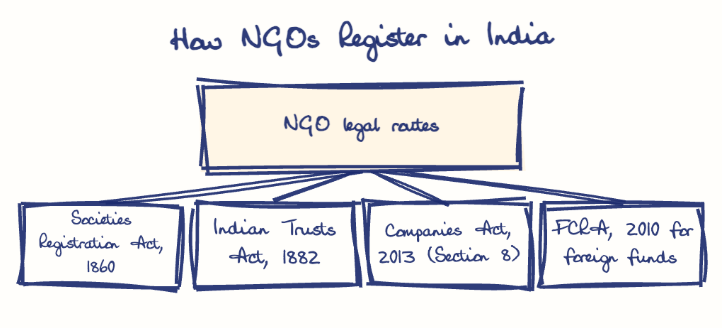
The UN partners with civil society because CSOs reach marginalised communities, promote inclusion, strengthen transparency and deliver services and disaster relief. In India, NGOs register under the Societies Registration Act, 1860, the Indian Trusts Act, 1882 (with state laws for public trusts) or Section 8 of the Companies Act, 2013.
Model answer
Ghissu Editorial · Verified 4 Oct 2026 · 268 words
Constitutional and Legal Basis
Article 19(1)(c) guarantees association rights; NGOs register under the Societies Registration Act, 1860, Indian Trusts Act, 1882, or Companies Act, 2013 (Section 8). SEWA and Akshaya Patra Foundation exemplify these models, enabling formal governance and large-scale service delivery.
State Regulation under Entry 32 (List II)
Civil society regulation falls under state jurisdiction via the Societies Registration Act and related laws, ensuring local governance of NGOs. This decentralised framework allows states to tailor oversight to regional needs.
Bridging Governance and Promoting Inclusion
NGOs reach marginalized groups, foster participatory democracy, and support SDGs, as seen in Andhra Pradesh’s rural initiatives. They empower women, Scheduled Castes, and Tribes, advancing social equity.
FCRA Amendments and NGO Operations
The 2010 Act’s recent amendments impose strict foreign funding rules2, causing widespread FCRA cancellations and operational hurdles. This affects NGOs’ ability to sustain programs and maintain transparency.
Strengthen Transparency and Capacity
Expand digital platforms like NGO-DARPAN for real-time monitoring and accountability. Invest in capacity building for rural NGOs, especially in backward districts of Andhra Pradesh, to bridge urban-rural disparities and enhance grassroots impact.
This model answer is indicative and the model can make mistakes; please verify key facts independently.
Practise this question
1Get the answer sheet
Sized for this question.
2Write your answer
Timed, by hand.
3Get it marked
Your score and what to fix.
This chapter in the exam
Development processes: civil society and NGOs7 questions
Asked in 3 of 8 sittings since 2008
Most tested: Role of NGOs/civil society in democracy and social justice
- 2025What do you understand by civil society in the Indian context? Discuss its key features and the limitations it faces in a democratic system.
- 2025In what ways can the role of NGOs be enhanced in promoting women's empowerment and welfare in India? Discuss, with a focus on the key challenges they encounter.
All 7 questions, sorted by sub-topic, with model answers and practice.
Question from the official APPSC Group-I Mains 2020 paper. Answer written by Ghissu's engine and checked against our editorial standards. Found an error? Tell us and we correct it within 48 hours.