How was the Constituent Assembly formed that framed the Indian constitution? Critically evaluate the Constitution of India as framed by the Constituent Assembly.
In short
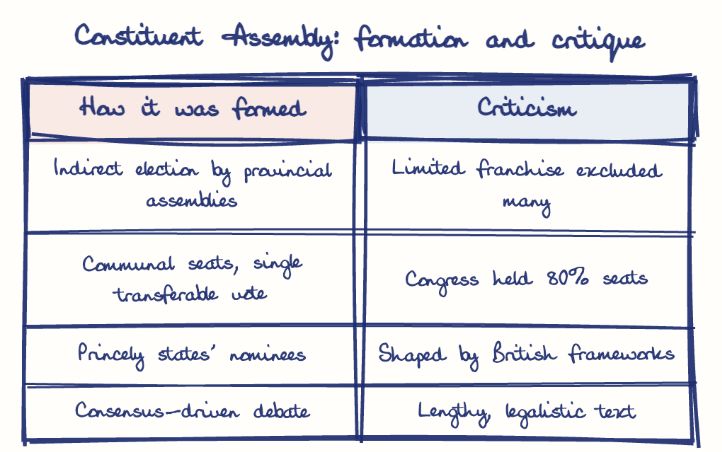
The Constituent Assembly, formed in 1946 under the Cabinet Mission Plan, was indirectly elected by provincial assemblies on a limited franchise, with nominated princely state members, and it framed a Constitution balancing unity with diversity. Critics note its restricted franchise and Congress dominance, with over 80% of seats after partition.
Model answer
Ghissu Editorial · Verified 4 Oct 2026 · 279 words
Indirect Election with Limited Franchise
Members were elected by provincial assemblies under the Government of India Act, 1935, which excluded over 70% of adults, limiting democratic legitimacy and leaving large rural and marginalized populations unrepresented.
Communal and Princely State Inclusion
Seats were allocated among Muslims, Sikhs, and General categories via proportional representation; princely states nominated members, ensuring pan-Indian representation and integrating semi-autonomous regions into the constitutional process.
Congress2 Dominance and Political Homogeneity
Post-partition, Congress held over 80% of seats, concentrating power and limiting pluralism, which some argue stifled broader political debate and marginalized minority voices.
British Influence and Legal Complexity
The Assembly operated within British legal frameworks, reflecting transitional sovereignty; the Constitution’s detailed and voluminous nature made governance complex and sometimes inaccessible to ordinary citizens.
Enhance Democratic Participation and Federalism
Reforms should deepen citizen engagement3, especially from marginalized groups, and strengthen cooperative federalism to address regional issues like those in Andhra Pradesh, including demands post-bifurcation and water disputes.
Simplify Constitutional Provisions and Institutionalize Consensus
Periodic reviews can reduce complexity and improve accessibility; adopting the Assembly’s consensus-driven approach in amendments can sustain democratic stability and accommodate diverse interests.
This model answer is indicative and the model can make mistakes; please verify key facts independently.
Practise this question
1Get the answer sheet
Sized for this question.
2Write your answer
Timed, by hand.
3Get it marked
Your score and what to fix.
This chapter in the exam
Indian Constitution, Fundamental Rights, DPSP and Union-State functions18 questions
Asked in 8 of 8 sittings since 2008
Most tested: Rights, social justice, and constitutional safeguards for disadvantaged groups.
- 2025The Indian Constitution favours a federal type of government. Considering this, what duties does the Constitution place on State Governments to ensure the smooth functioning of the nation?
- 2025The Constitution of India grants certain rights to citizens and also provides measures to safeguard them. What are the key constitutional arrangements to ensure the protection of these rights?
All 18 questions, sorted by sub-topic, with model answers and practice.
Question from the official APPSC Group-I Mains 2020 paper. Answer written by Ghissu's engine and checked against our editorial standards. Found an error? Tell us and we correct it within 48 hours.