What are the necessity and importance of labour laws? Are India's labour law reforms only a gift for factories or do workers benefit too?
In short
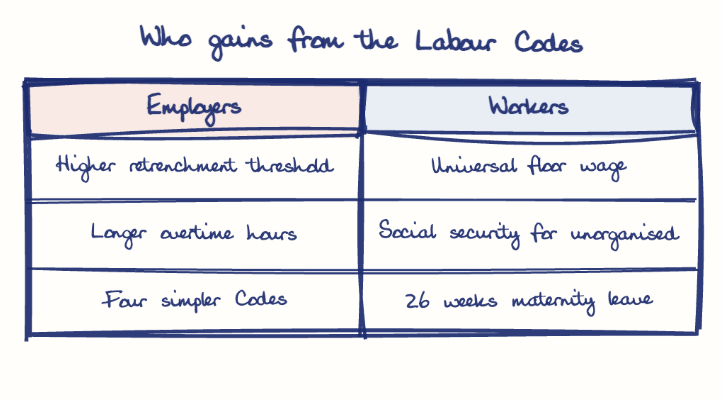
Labour laws secure fair wages, safe workplaces and social security, and India's merger of 29 laws into four Labour Codes is no mere gift to factories. Firms gain retrenchment and overtime flexibility, but workers gain a universal floor wage, social security for gig workers and 26 weeks' maternity leave.
Model answer
Ghissu Editorial · Verified 4 Oct 2026 · 245 words
Labour Codes Consolidation
The four Labour Codes, Wages, Industrial Relations, Social Security, Occupational Safety, reflect the Second National Commission on Labour’s vision, reducing complexity for businesses and workers.
Universal Minimum Wage
The Code on Wages introduces a statutory floor wage applicable across organized and unorganized sectors, benefiting workers in Andhra Pradesh’s MSME clusters and promoting wage equity.
Expanded Social Security Coverage
The Social Security Code extends benefits like health insurance and maternity leave to unorganized workers, crucial for vulnerable groups in Andhra Pradesh’s informal sectors such as aquaculture.
Women’s Labour Rights Expansion
Reforms increasing maternity leave to 26 weeks and allowing night shifts empower women workers, enhancing gender equity in Andhra Pradesh.
Strengthen Awareness and Enforcement
Andhra Pradesh should enhance outreach via digital platforms like Shram Suvidha Portal3 and improve labour inspections in industrial zones to ensure compliance without harassment.
Promote Social Security Enrollment
Facilitate informal workers’ registration in sectors like aquaculture and horticulture in Andhra Pradesh by integrating with state welfare schemes.
This model answer is indicative and the model can make mistakes; please verify key facts independently.
Practise this question
1Get the answer sheet
Sized for this question.
2Write your answer
Timed, by hand.
3Get it marked
Your score and what to fix.
This chapter in the exam
Basic Knowledge of Laws in India6 questions
Asked in 3 of 8 sittings since 2008
Most tested: Contemporary statutory frameworks and their practical relevance, especially cyber law and tax/labour law reforms.
- 2025What do you understand by cyberstalking? What are the various other cyber offences recognised under Information Technology Act, 2000?
- 2025What is GST? Discuss the regulatory framework of GST in India, including Constitutional provisions applicable to GST.
All 6 questions, sorted by sub-topic, with model answers and practice.
Question from the official APPSC Group-I Mains 2020 paper. Answer written by Ghissu's engine and checked against our editorial standards. Found an error? Tell us and we correct it within 48 hours.