What is GST? Discuss the regulatory framework of GST in India, including Constitutional provisions applicable to GST.
In short
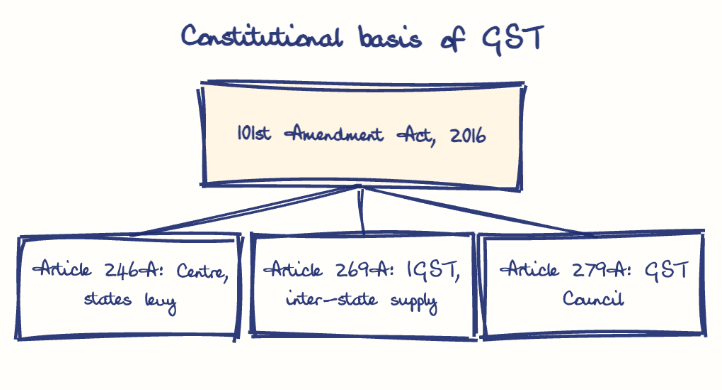
GST, introduced on 1 July 2017, is a unified indirect tax that turned India into a single common market. The 101st Amendment Act, 2016 inserted Articles 246A, 269A and 279A, which enable concurrent levy and create the GST Council, backed by the CGST, SGST and IGST Acts.
Model answer
Ghissu Editorial · Verified 4 Oct 2026 · 255 words
Legislative and Administrative Setup
The Central GST Act, State GST Acts, Integrated GST Act, and Compensation Act form the statutory basis; the GST Secretariat and CBIC manage policy and enforcement, supported by GSTN’s IT platform.
Tax Structure and Revenue Impact
Initial multiple slabs (5%, 12%, 18%, 28%) were simplified under GST 2.0; Andhra Pradesh4’s CAG audit reported ₹1,806 crore in GST compliance gaps, underscoring enforcement issues.
Formalisation and Dispute Resolution
Input tax credit incentivises formalisation; the GST Appellate Tribunal enhances dispute resolution efficiency.
Simplification and Inclusion
Rationalising slabs and expanding the composition scheme threshold can ease compliance; including petroleum and electricity under GST would benefit industrial states like Andhra Pradesh.
Compliance and Federal Cooperation
Increasing audit coverage from 62% to 89% and empowering the GST Council with transparent decision-making will strengthen revenue realisation and cooperative federalism.
This model answer is indicative and the model can make mistakes; please verify key facts independently.
Practise this question
1Get the answer sheet
Sized for this question.
2Write your answer
Timed, by hand.
3Get it marked
Your score and what to fix.
This chapter in the exam
Basic Knowledge of Laws in India6 questions
Asked in 3 of 8 sittings since 2008
Most tested: Contemporary statutory frameworks and their practical relevance, especially cyber law and tax/labour law reforms.
- 2025What do you understand by cyberstalking? What are the various other cyber offences recognised under Information Technology Act, 2000?
- 2023Define Substantive Law and Procedural Law. Discuss the interrelationship and differences between Substantive Law and Procedural Law.
All 6 questions, sorted by sub-topic, with model answers and practice.
Question from the official APPSC Group-I Mains 2025 paper. Answer written by Ghissu's engine and checked against our editorial standards. Found an error? Tell us and we correct it within 48 hours.