What do you understand by the values of an entity? What is the need for value education? Discuss how gender inequality came to be recognised as inequality in the Indian context and the kind of responses that this recognition produced.
In short
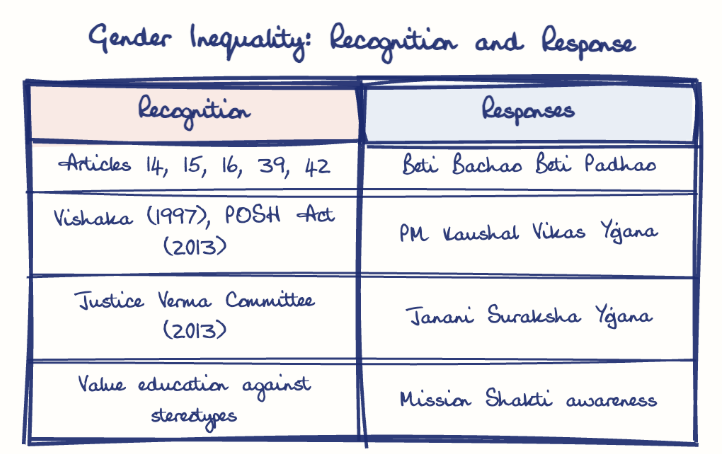
An entity's values are core principles guiding its behaviour, and value education nurtures ethical awareness and equality from an early age. Gender inequality was recognised through Articles 14 and 15, the Vishaka judgment (1997) and the Justice Verma Committee (2013), prompting responses like Beti Bachao Beti Padhao and Mission Shakti.
Model answer
Ghissu Editorial · Verified 4 Oct 2026 · 267 words
Judicial and Policy Measures
Vishaka v. Rajasthan (1997) led to the POSH Act (2013) against workplace harassment; the Justice Verma Committee (2013) recommended stricter laws on gender violence and emphasized gender sensitization, showing institutional commitment to structural change.
Government Schemes and Social Norms
Beti Bachao Beti Padhao raised girls’ enrolment by 8% in targeted districts, including in Andhra Pradesh; PM Kaushal Vikas Yojana trained 1.2 million women; yet persistent patriarchal norms and stereotypes continue to impede progress, highlighting the need for value education that fosters mutual respect and dignity.
Education’s Role and Health Initiatives
Gender sensitivity integrated into curricula and campaigns like Mission Shakti (reaching 10 million women) promote ethical citizenship and challenge stereotypes; programs such as Janani Suraksha Yojana have increased institutional deliveries to 85%, improving maternal health but requiring sustained advocacy for reproductive rights.
Value Education and Enforcement
Integrate gender sensitivity systematically in education; strengthen women’s police stations and fast-track courts in Andhra Pradesh to ensure effective law enforcement.
Economic Inclusion and Community Engagement
Expand women’s skill development and entrepreneurship programs; partner with media and local communities to challenge patriarchal norms and promote positive narratives on gender equality.
This model answer is indicative and the model can make mistakes; please verify key facts independently.
Sources
Practise this question
1Get the answer sheet
Sized for this question.
2Write your answer
Timed, by hand.
3Get it marked
Your score and what to fix.
This chapter in the exam
Human values6 questions
Asked in 3 of 8 sittings since 2008
Most tested: Sources and transmission of values through family, society and education
- 2025What ethical values are essential to ensure peaceful coexistence in a diverse society? Illustrate your answer with suitable examples.
- 2025How does early value education in the family influence ethical decision-making in adulthood?
All 6 questions, sorted by sub-topic, with model answers and practice.
Question from the official APPSC Group-I Mains 2020 paper. Answer written by Ghissu's engine and checked against our editorial standards. Found an error? Tell us and we correct it within 48 hours.