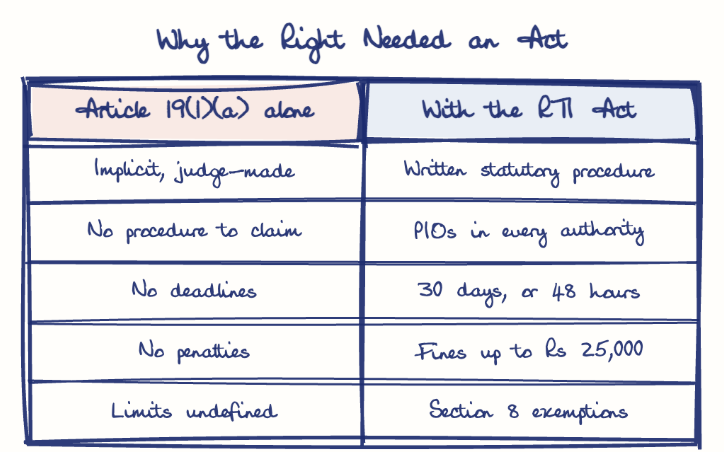
What is RTI? What rights are available under RTI Act 2005? If RTI is a Fundamental Right, then why do we need an Act to give us this Right?
In short
RTI, which the Supreme Court reads into Articles 19(1)(a) and 21, lets citizens obtain information from public authorities within 30 days, plus proactive disclosure and appeals. An Act is needed to operationalise it: it creates PIOs and Information Commissions, defines Section 8 exemptions and imposes penalties up to ₹25,000.
Model answer
Ghissu Editorial · Verified 4 Oct 2026 · 254 words
Constitutional Basis of RTI
The Supreme Court recognized RTI as part of fundamental rights, interpreting it as intrinsic to freedom of speech and the right to life, laying the groundwork for the Act.
Structured Access Mechanism
The Act mandates Public Information Officers and Assistant PIOs in every public authority, with Central and State Information Commissions to ensure transparency and adjudicate appeals, institutionalizing citizens’ access to information.
Impact on Governance
RTI disclosures have improved accountability, notably in Andhra Pradesh’s public distribution and welfare schemes, exposing corruption and inefficiencies and enhancing service delivery to marginalized groups.
Implementation Challenges
Low public awareness, understaffed and underfunded Information Commissions, limited proactive disclosure, and threats to RTI activists hinder the Act’s effectiveness and timely grievance redressal.
Way Forward
Enhancing awareness campaigns in Andhra Pradesh, strengthening PIO training and staffing, increasing funding for Information Commissions, and promoting e-governance and digital platforms are essential to improve access and enforcement.
This model answer is indicative and the model can make mistakes; please verify key facts independently.
Practise this question
1Get the answer sheet
Sized for this question.
2Write your answer
Timed, by hand.
3Get it marked
Your score and what to fix.
This chapter in the exam
Good governance, e-governance, RTI and Social Audit8 questions
Asked in 4 of 8 sittings since 2008
Most tested: RTI as a transparency and accountability instrument within good governance
- 2025Define good governance. How does the Right to Information (RTI) Act promote the principles of good governance in India?
- 2025Social audit helps to narrow gaps between vision and reality. Examine the statement and also discuss the impediments in the institutionalisation of social audit in India.
All 8 questions, sorted by sub-topic, with model answers and practice.
Question from the official APPSC Group-I Mains 2020 paper. Answer written by Ghissu's engine and checked against our editorial standards. Found an error? Tell us and we correct it within 48 hours.