What is social audit? What are its objectives and advantages?
In short
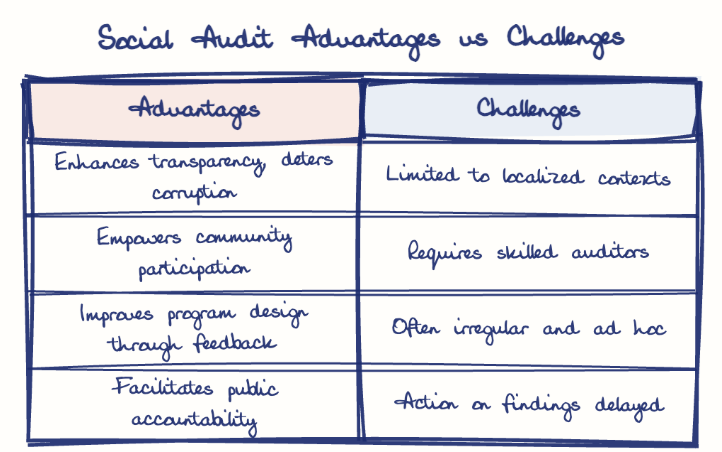
Social audit is community verification, through Gram Sabhas, of how public funds and schemes are used, mandated by the MGNREGA Act, 2005, to ensure transparency, accountability and participation. It curbs corruption, recovers misused funds, empowers marginalised groups and improves programmes, as Andhra Pradesh's SSAAT model shows.
Model answer
Ghissu Editorial · Verified 4 Oct 2026 · 336 words
Legal Mandate under MGNREGA
The 2005 Act institutionalized social audits to monitor rural employment schemes, with Andhra Pradesh pioneering regular audits that detect and prevent fund misuse.
Autonomous Social Audit Bodies
States like Andhra Pradesh have dedicated units ensuring systematic, well-resourced audits integrated with Panchayati Raj institutions empowered by the 73rd Amendment.
State-Level Legal Expansion
Some states, including Meghalaya, have enacted laws to formalize social audits beyond MGNREGA, inspired by Andhra Pradesh’s institutional framework.
Transparency and Accountability Gains
Social audits revealed irregularities in Rajasthan and Andhra Pradesh, leading to fund recovery and enhanced public trust.
Community Participation
Gram Sabhas’ involvement strengthens democratic governance and empowers marginalized groups, especially in Andhra Pradesh’s decentralized model.
Capacity Challenges
Shortage of trained auditors affects audit quality, highlighting the need for enhanced capacity-building in states like Andhra Pradesh.
Ensuring Transparency
Social audits verify fund use and reduce corruption, as in Andhra Pradesh’s MGNREGA audits that recovered misused funds.
Improving Program Effectiveness
Audits generate data for policy adjustments, improving services in Odisha and Andhra Pradesh, such as nutrition schemes.
Expand Training
Build skilled auditors in Andhra Pradesh through specialized modules to improve audit consistency.
This model answer is indicative and the model can make mistakes; please verify key facts independently.
Sources
Practise this question
1Get the answer sheet
Sized for this question.
2Write your answer
Timed, by hand.
3Get it marked
Your score and what to fix.
This chapter in the exam
Good governance, e-governance, RTI and Social Audit8 questions
Asked in 4 of 8 sittings since 2008
Most tested: RTI as a transparency and accountability instrument within good governance
- 2025Define good governance. How does the Right to Information (RTI) Act promote the principles of good governance in India?
- 2025Social audit helps to narrow gaps between vision and reality. Examine the statement and also discuss the impediments in the institutionalisation of social audit in India.
All 8 questions, sorted by sub-topic, with model answers and practice.
Question from the official APPSC Group-I Mains 2020 paper. Answer written by Ghissu's engine and checked against our editorial standards. Found an error? Tell us and we correct it within 48 hours.