What is the role of family, society and educational institutions in inculcating values?
In short
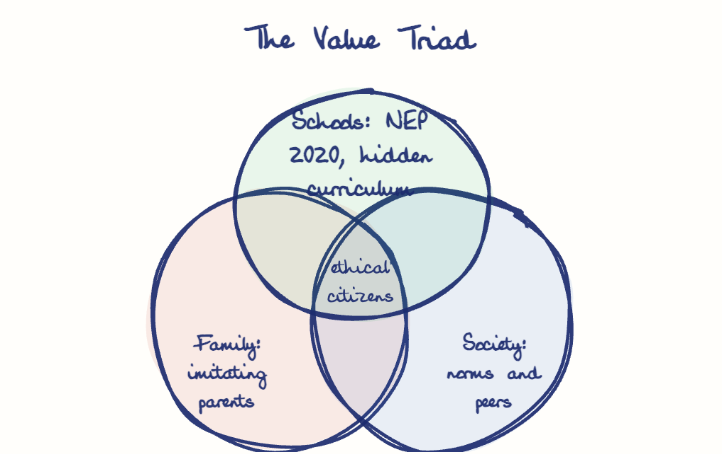
The family instils core values through primary socialisation, society reinforces or erodes them through norms and peers, and educational institutions teach them formally and through a hidden curriculum. The National Education Policy 2020 stresses such learning, and Andhra Pradesh is integrating value education in its schools.
Model answer
Ghissu Editorial · Verified 4 Oct 2026 · 282 words
Primary Socialisation in Family
Family is the first social unit teaching honesty and integrity, supported by A.P.J. Abdul Kalam’s view that parents and teachers are key to a corruption-free society. Early childhood experiences in families shape lifelong moral foundations.
Formal Ethical Learning
Schools provide structured teaching of discipline and civic responsibility, with NEP 2020 emphasizing value-based experiential learning. This formal environment complements family efforts by instilling respect and social responsibility.
Collaborative Value Formation
Programs like the Delhi Happiness Curriculum and Andhra Pradesh’s value education efforts show schools partnering with families to nurture social harmony and emotional intelligence, demonstrating the synergy between home and school in value inculcation.
Modern Challenges
Changing family structures and social media influence complicate value inculcation, requiring support from schools and community programs. India’s pluralistic society also demands inclusive education to manage value conflicts and promote tolerance.
Way Forward
Strengthen family-school partnerships through community engagement, integrate value education reflecting local contexts, promote inclusive societal norms, and develop ethical digital literacy to guide youth in navigating media influences responsibly.
This model answer is indicative and the model can make mistakes; please verify key facts independently.
Practise this question
1Get the answer sheet
Sized for this question.
2Write your answer
Timed, by hand.
3Get it marked
Your score and what to fix.
This chapter in the exam
Human values6 questions
Asked in 3 of 8 sittings since 2008
Most tested: Sources and transmission of values through family, society and education
- 2025What ethical values are essential to ensure peaceful coexistence in a diverse society? Illustrate your answer with suitable examples.
- 2025How does early value education in the family influence ethical decision-making in adulthood?
All 6 questions, sorted by sub-topic, with model answers and practice.
Question from the official APPSC Group-I Mains 2020 paper. Answer written by Ghissu's engine and checked against our editorial standards. Found an error? Tell us and we correct it within 48 hours.