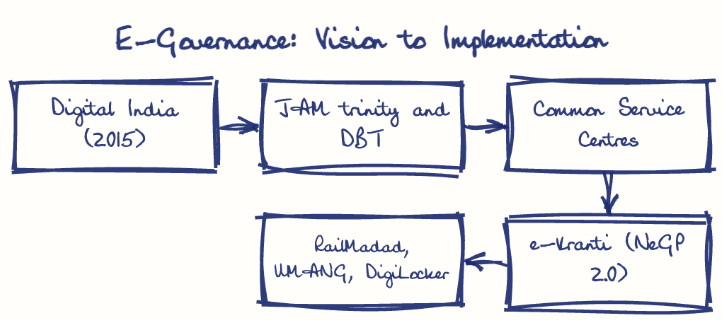
Why does the Indian Government make use of the e-governance strategy? Mention the several initiatives in the journey from e-governance vision to implementation. How can we say that the Indian government is accountable, responsive and legitimate government?
In short
India uses e-governance to make service delivery transparent, accountable and efficient, through initiatives like Digital India (2015), Aadhaar and the JAM Trinity for DBT, Common Service Centres and e-Kranti. Grievance platforms like RailMadad and e-Taal and integrated services like UMANG and DigiLocker make the government accountable, responsive and legitimate.
Model answer
Ghissu Editorial · Verified 4 Oct 2026 · 275 words
Audit Reveals Systemic Gaps
Andhra Pradesh’s CFMS audit found ₹968 crore excess payments due to system lapses, showing why backend integration and audit trails matter in e-governance.
Transparency and Cybersecurity
Platforms like UMANG, DigiLocker, and Government e-Marketplace improve service delivery and grievance redressal; however, over 22 lakh cyber fraud incidents highlight cybersecurity needs.
Strengthen Integration and Literacy
Enhance interoperability frameworks to avoid errors like those in Andhra Pradesh’s financial systems; expand digital literacy via DIKSHA and OpenForge.
Enhance Cybersecurity and Feedback
Invest in cybersecurity infrastructure and institutionalize real-time grievance mechanisms to boost government accountability and legitimacy.
This model answer is indicative and the model can make mistakes; please verify key facts independently.
Practise this question
1Get the answer sheet
Sized for this question.
2Write your answer
Timed, by hand.
3Get it marked
Your score and what to fix.
This chapter in the exam
Good governance, e-governance, RTI and Social Audit8 questions
Asked in 4 of 8 sittings since 2008
Most tested: RTI as a transparency and accountability instrument within good governance
- 2025Define good governance. How does the Right to Information (RTI) Act promote the principles of good governance in India?
- 2025Social audit helps to narrow gaps between vision and reality. Examine the statement and also discuss the impediments in the institutionalisation of social audit in India.
All 8 questions, sorted by sub-topic, with model answers and practice.
Question from the official APPSC Group-I Mains 2020 paper. Answer written by Ghissu's engine and checked against our editorial standards. Found an error? Tell us and we correct it within 48 hours.