Discuss the factors responsible for the high infant mortality rate and maternal mortality rate in India? What policy measures do you suggest to improve these indicators?
In short
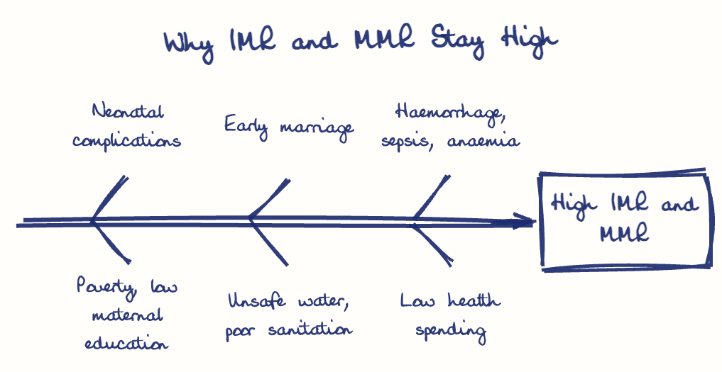
High infant and maternal mortality in India stem from neonatal and obstetric complications, malnutrition, early marriage, poor sanitation, low institutional delivery and weak public health spending. Key remedies are filling health staff vacancies, empowering ASHA and anganwadi workers, scaling Janani Suraksha Yojana and raising health budgets.
Model answer
Ghissu Editorial · Verified 4 Oct 2026 · 271 words
Neonatal Complications and Healthcare Gaps
Preterm birth complications and infections remain leading causes, worsened by inadequate institutional care and skilled staff shortages in rural India.
Socio-economic and Cultural Barriers
Poverty, low maternal education, and gender discrimination limit healthcare access, with Scheduled Tribes and rural populations disproportionately affected.
Low Institutional Delivery and Antenatal Care
Despite improvements, many women still deliver at home due to fear or access issues; only 70% receive first trimester antenatal visits.
Strengthening Health Infrastructure and Workforce
Upgrade facilities and fill vacancies, prioritizing underserved areas like Andhra Pradesh’s shortage of Community Health Centres4.
Promoting Institutional Deliveries and Antenatal Care
Scale up Janani Suraksha Yojana and Pradhan Mantri Matru Vandana Yojana with better monitoring and incentives.
Increasing Public Health Expenditure and Data Systems
Raise health budgets and improve data collection for targeted interventions.
This model answer is indicative and the model can make mistakes; please verify key facts independently.
Practise this question
1Get the answer sheet
Sized for this question.
2Write your answer
Timed, by hand.
3Get it marked
Your score and what to fix.
This chapter in the exam
Inclusive Growth: India and AP schemes49 questions
Asked in 8 of 8 sittings since 2008
Most tested: Women empowerment and poverty reduction through AP welfare and credit-linked institutions
- 2025Elaborate on the meaning of Inclusive Growth in the context of the Indian economy. Discuss the key strategies and instruments that can be employed to foster greater inclusion and ensure that the benefits of economic growth reach all sections of society.
- 2025Critically Examine the major poverty alleviation and employment generation programmes in India. How effective have they been in addressing rural and urban poverty?
All 49 questions, sorted by sub-topic, with model answers and practice.
Question from the official APPSC Group-I Mains 2020 paper. Answer written by Ghissu's engine and checked against our editorial standards. Found an error? Tell us and we correct it within 48 hours.