Classify solid waste in terms of source and types of solid wastes. Explain the steps to manage this waste. Add a note on advantages and disadvantages of landfills.
In short
By source, solid waste is municipal, industrial, agricultural, biomedical or e-waste, and by type biodegradable, non-biodegradable, recyclable, hazardous or inert, managed through segregation, collection, processing such as composting, and disposal. Landfills are simple and cheap, but unlined ones leak leachate into groundwater, which costlier sanitary landfills prevent.
Model answer
Ghissu Editorial · Verified 4 Oct 2026 · 305 words
Source and Type
Waste is classified by origin (municipal, industrial, agricultural, biomedical, e-waste) and by type (biodegradable, non-biodegradable, recyclable, hazardous, inert). Andhra Pradesh’s agrarian economy yields mostly biodegradable waste, but urban areas like Visakhapatnam face increasing non-biodegradable and hazardous waste. This classification guides appropriate handling and disposal methods.
Management Steps
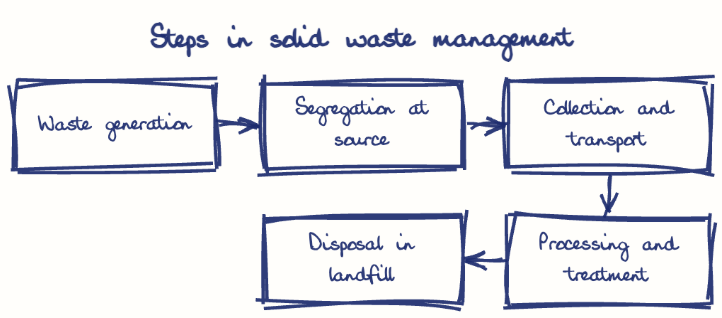
Segregation at source into biodegradable, recyclable, and non-recyclable waste is critical; Andhra Pradesh’s 2022 audit revealed only 75% actual segregation despite claims of 98%. Collection uses colour-coded bins, followed by processing (composting, recycling, biomethanation) and disposal. Efficient collection and transportation reduce littering and contamination.
Advantages
Landfills are cost-effective, reduce odor and pests by daily soil covering, and can be repurposed post-closure as parks or parking lots, aiding urban land use.
Disadvantages
Traditional landfills cause leachate contamination and methane emissions. In Andhra Pradesh, only 4 out of 123 ULBs had sanitary landfills in 2022, highlighting infrastructure gaps. Methane contributes to climate change, and leachate pollutes groundwater.
Sanitary Landfills
Engineered with impermeable liners to prevent leachate leakage, sanitary landfills are more sustainable but costly to build and maintain, requiring investment for wider adoption.
This model answer is indicative and the model can make mistakes; please verify key facts independently.
Sources
Practise this question
1Get the answer sheet
Sized for this question.
2Write your answer
Timed, by hand.
3Get it marked
Your score and what to fix.
This chapter in the exam
Pollution & solid waste; global issues; environmental legislation; disaster management policy; agricultural revolutions43 questions
Asked in 8 of 8 sittings since 2008
Most tested: Solid waste management and pollution-control legislation
- 2025What are the key principles of Integrated Solid Waste Management (ISWM)? Discuss the role of waste hierarchy in ISWM.
- 2025Define global warming, and differentiate it clearly from climate change. Explain the key natural and human-induced causes of global warming and briefly discuss which factors are currently dominant in driving global temperature rise.
All 43 questions, sorted by sub-topic, with model answers and practice.
Question from the official APPSC Group-I Mains 2020 paper. Answer written by Ghissu's engine and checked against our editorial standards. Found an error? Tell us and we correct it within 48 hours.