What are biofuels and why are they important to India's economy? What do you know about the Indian National Policy on Biofuels?
In short
Biofuels are fuels such as ethanol and biodiesel made from biomass, important because India imports over 85% of its crude oil, so they cut imports while raising farm incomes. The National Policy on Biofuels (2018) widened feedstocks to agro-waste and damaged grains, promoted 2G ethanol and targets 20% ethanol blending.
Model answer
Ghissu Editorial · Verified 4 Oct 2026 · 254 words
Policy Milestones
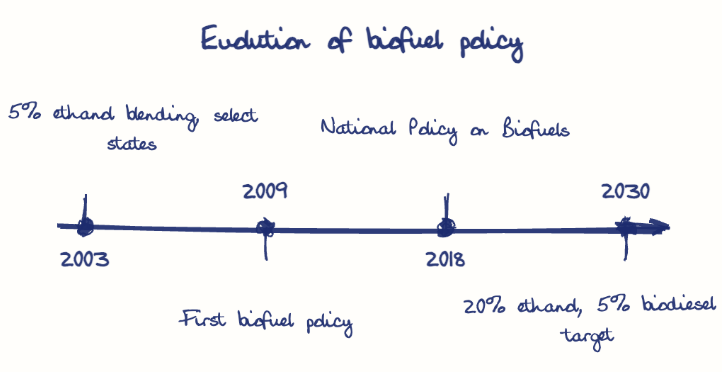
Starting with 5% ethanol blending in 2003, the 2018 National Biofuel Policy broadened feedstock to agro-waste, surplus grains, and non-edible oils, targeting 20% ethanol and 5% biodiesel by 2030. This evolution reflects a strategic move to diversify raw materials and improve fuel availability.
Economic Benefits
Biofuels reduce crude oil imports, generate rural employment, and support Aatmanirbhar Bharat and Make in India goals. They also improve farmer incomes by creating new markets for agricultural residues and non-food crops.
Environmental Gains
Using agricultural residues and waste aligns with Swachh Bharat Abhiyan by managing waste and lowering pollution. It also mitigates greenhouse gas emissions by replacing fossil fuels, contributing to India’s climate commitments under the Paris Agreement.
Innovation Support
The BioE3 Policy and Bio-RIDE scheme promote R&D in biofuel technologies, enhancing indigenous capabilities. These initiatives focus on advanced conversion technologies and sustainable feedstock development to overcome current limitations.
This model answer is indicative and the model can make mistakes; please verify key facts independently.
Practise this question
1Get the answer sheet
Sized for this question.
2Write your answer
Timed, by hand.
3Get it marked
Your score and what to fix.
This chapter in the exam
Human diseases; genetic engineering basics; biotechnology in agriculture; vaccines54 questions
Asked in 8 of 8 sittings since 2008
Most tested: Vaccines and immunisation, alongside GM crops/biotech agriculture.
- 2025Discuss the transmission dynamics of respiratory tract infections in densely populated urban settings. Propose effective public health strategies for their prevention.
- 2025Examine how urban infrastructure influences the implementation of preventive measures during microbial disease outbreaks. Suggest technology-driven solutions.
All 54 questions, sorted by sub-topic, with model answers and practice.
Question from the official APPSC Group-I Mains 2020 paper. Answer written by Ghissu's engine and checked against our editorial standards. Found an error? Tell us and we correct it within 48 hours.