What is recombinant DNA? Draw a schematic to show the process of creating rDNA and explain the roles of restriction enzymes and vectors in this process. Give an example of rDNA technology.
In short
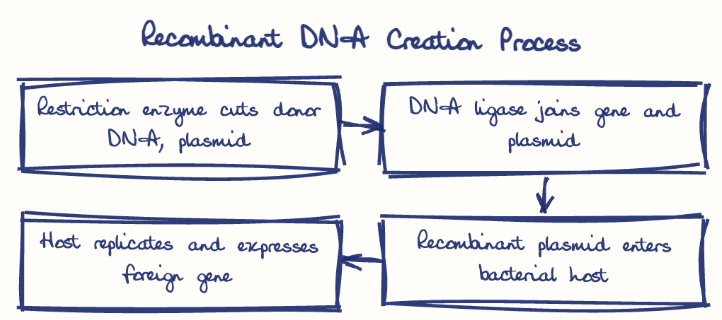
Recombinant DNA is artificial DNA made by joining fragments from different sources, using restriction enzymes to cut donor DNA and a plasmid vector at matching sites and ligase to seal the gene in. The vector carries it into a host, such as bacteria, which is how human insulin is produced.
Model answer
Ghissu Editorial · Verified 4 Oct 2026 · 308 words
Regulatory Oversight
DBT’s RDAC and RCGM set safety guidelines and monitor recombinant DNA research nationwide, including in Andhra Pradesh, ensuring ethical and secure practices.
Biosafety Committees and Infrastructure
Institutional Biosafety Committees (IBSCs) in Andhra Pradesh approve projects and maintain safety; equipped labs support DNA isolation, cloning, and analysis.
Human Resource Development
Academic courses and training programs in Andhra Pradesh develop skilled personnel capable of performing complex rDNA techniques, strengthening the biotechnology workforce.
Restriction Enzymes and Vectors
Restriction enzymes cut DNA at precise sequences; plasmid vectors from bacteria like E. coli carry foreign DNA, replicating independently to express target genes.
Stepwise Creation
The gene of interest is excised and ligated into plasmid vectors cut with the same enzyme, forming recombinant DNA introduced into host bacteria for replication and protein synthesis.
Medical Biotechnology
Production of human insulin using rDNA in E. coli is a landmark example, with Indian biotech firms and Andhra Pradesh research centers actively involved.
Agricultural Benefits
Genetically modified crops with pest resistance and drought tolerance aid farmers in regions like Rayalaseema.
Enhance Research Ecosystems
Boost funding and infrastructure in Andhra Pradesh for advanced recombinant DNA projects.
Expand Biosafety Training
Strengthen training programs to ensure safe, ethical rDNA use.
This model answer is indicative and the model can make mistakes; please verify key facts independently.
Practise this question
1Get the answer sheet
Sized for this question.
2Write your answer
Timed, by hand.
3Get it marked
Your score and what to fix.
This chapter in the exam
Human diseases; genetic engineering basics; biotechnology in agriculture; vaccines54 questions
Asked in 8 of 8 sittings since 2008
Most tested: Vaccines and immunisation, alongside GM crops/biotech agriculture.
- 2025Discuss the transmission dynamics of respiratory tract infections in densely populated urban settings. Propose effective public health strategies for their prevention.
- 2025Examine how urban infrastructure influences the implementation of preventive measures during microbial disease outbreaks. Suggest technology-driven solutions.
All 54 questions, sorted by sub-topic, with model answers and practice.
Question from the official APPSC Group-I Mains 2020 paper. Answer written by Ghissu's engine and checked against our editorial standards. Found an error? Tell us and we correct it within 48 hours.