Describe the characteristic features of Black and Alluvial soils of Andhra Pradesh.
In short
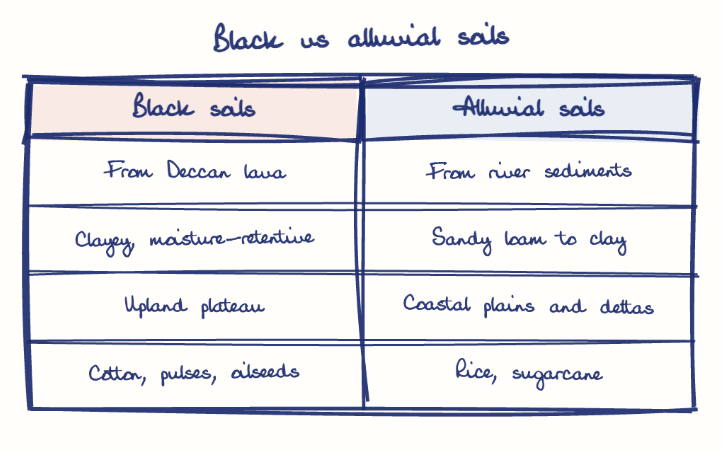
Black soils of Andhra Pradesh are clayey, moisture-retentive, self-ploughing soils rich in lime and potash, found mainly in Kurnool, Kadapa and Prakasam and suited to cotton and pulses, while alluvial soils are fertile river deposits of the coastal deltas. Godavari and Krishna delta alluvium makes the state a rice bowl.
Model answer
Ghissu Editorial · Verified 4 Oct 2026 · 284 words
Origin and Composition
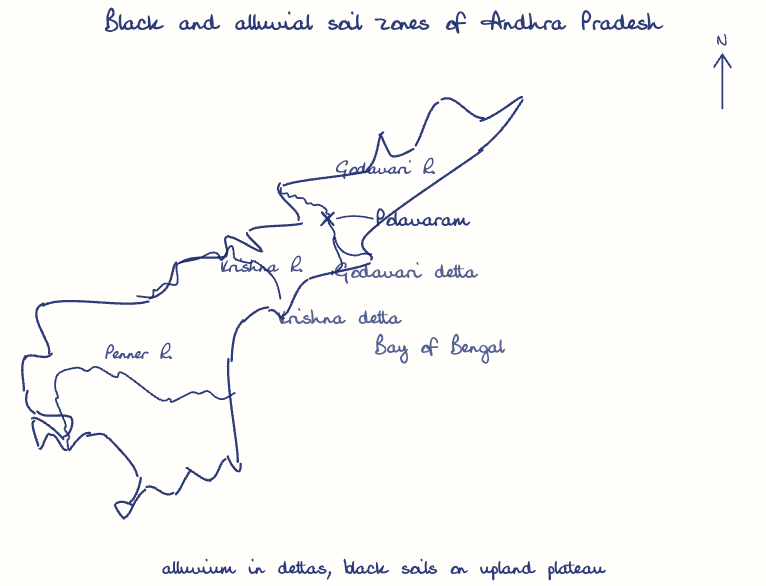
In Andhra Pradesh black soils derive mainly from weathered basic rocks, shales and limestones of the Cuddapah and Kurnool basins, rich in clay and moisture-retentive, ideal for cotton, hence called "Black Cotton Soils." Their shrink-swell capacity aids natural soil aeration.
Distribution and Fertility
Predominantly in Kurnool, Kadapa, Prakasam and Guntur, these soils contain calcium carbonate, magnesium, potash, and lime, supporting cotton, pulses, and maize despite low organic matter. Their moisture retention is crucial in semi-arid zones.
Formation and Distribution
Alluvial soils form from sediments of Godavari, Krishna, and Penneru rivers, found extensively in coastal plains and deltas like East and West Godavari, supporting intensive agriculture. They include Bangar (older) and Khadar (newer) variants.
Fertility and Irrigation
Rich in potash, phosphoric acid, and lime, alluvial soils support rice, sugarcane, and banana; irrigation projects such as the Polavaram Project improve water availability and crop yields. These soils benefit from continuous mineral replenishment by river action.
Soil and Water Management
Promote integrated nutrient management and organic farming, leveraging schemes like Andhra Pradesh Community Managed Natural Farming (APCNF), and enhance irrigation infrastructure via Polavaram to sustain agriculture.
Crop Diversification and Monitoring
Encourage crop diversification suited to soil types and implement GIS-based soil mapping to optimize land use and improve productivity sustainably.
This model answer is indicative and the model can make mistakes; please verify key facts independently.
Practise this question
1Get the answer sheet
Sized for this question.
2Write your answer
Timed, by hand.
3Get it marked
Your score and what to fix.
This chapter in the exam
Physical Features and Resources6 questions
Asked in 3 of 8 sittings since 2008
Most tested: Major landforms and physical features of Andhra Pradesh
- 2025Explain the physical features of India and Andhra Pradesh, especially the major landforms and geographical characteristics.
- 2025Examine the features and importance of the major landforms of Andhra Pradesh with special reference to the Coastal Plains, Eastern Ghats, and Deccan Plateau.
All 6 questions, sorted by sub-topic, with model answers and practice.
Question from the official APPSC Group-I Mains 2023 paper. Answer written by Ghissu's engine and checked against our editorial standards. Found an error? Tell us and we correct it within 48 hours.