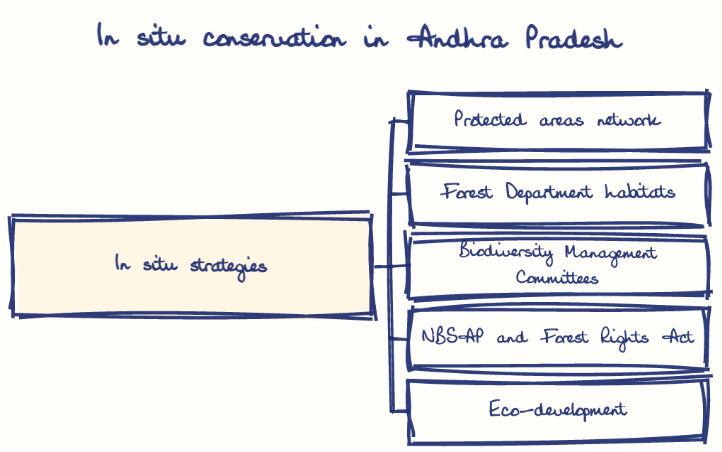
Discuss various in situ conservation strategies of biodiversity in Andhra Pradesh.
In short
In situ conservation in Andhra Pradesh protects species in their natural habitats through protected areas, Biodiversity Management Committees with People's Biodiversity Registers, the Forest Rights Act and eco-development, though conflict and fragmentation persist. Key sites include the Nagarjunasagar-Srisailam Tiger Reserve, Coringa mangroves and the Seshachalam Biosphere Reserve.
Model answer
Ghissu Editorial · Verified 4 Oct 2026 · 242 words
Forest Department and Protected Areas54
The Andhra Pradesh Forest Department manages forests and mangroves in Godavari and Krishna estuaries, supporting species like fishing cats; protected areas align with India’s network safeguarding tigers and panthers. These sanctuaries serve as core zones for biodiversity conservation and ecological stability.
Community Governance
Biodiversity Management Committees6 under the Biodiversity Act maintain People’s Biodiversity Registers, fostering local stewardship and integrating traditional knowledge. This decentralized governance model empowers communities to document and protect biodiversity, enhancing conservation outcomes.
Mining and Governance Issues
Andhra Pradesh’s CAG audits highlight systemic mining governance gaps, and weak regulation of mining causes forest degradation. These challenges exacerbate habitat fragmentation and threaten species survival.
Integrate Conservation with Development
Enforce stringent environmental impact assessments for mining and infrastructure projects to protect biodiversity, mainstreaming conservation in state development policies and ensuring sustainable resource use.
This model answer is indicative and the model can make mistakes; please verify key facts independently.
Practise this question
1Get the answer sheet
Sized for this question.
2Write your answer
Timed, by hand.
3Get it marked
Your score and what to fix.
This chapter in the exam
Fauna and Floral Geography5 questions
Asked in 3 of 8 sittings since 2008
Most tested: Andhra Pradesh-specific wildlife and biodiversity conservation
- 2025Discuss the key aspects of wildlife conservation and biodiversity in Andhra Pradesh.
- 2023Discuss the various forest conservation programmes in India.
All 5 questions, sorted by sub-topic, with model answers and practice.
Question from the official APPSC Group-I Mains 2023 paper. Answer written by Ghissu's engine and checked against our editorial standards. Found an error? Tell us and we correct it within 48 hours.