Examine the socio-religious and cultural life of the Vijayanagara kingdom with respect to the writings of foreign travellers such as Nicolo Conti, Abdur Razzak, Duarte Barbosa and Domingo Paes.
In short
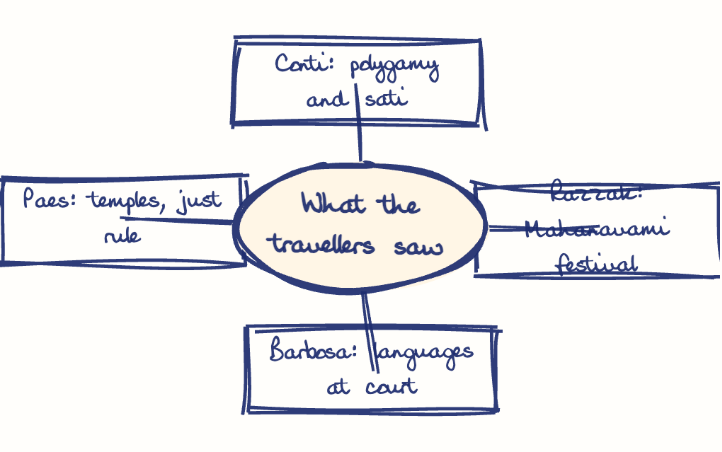
Foreign travellers portray Vijayanagara as devout, hierarchical yet dynamic and prosperous: Abdur Razzak described the Mahanavami festival, Nicolo Conti noted polygamy and sati, Paes praised its temples and Barbosa its plural court. Read critically, their accounts show a cosmopolitan culture whose legacy includes the Lepakshi murals in Andhra Pradesh.
Model answer
Ghissu Editorial · Verified 4 Oct 2026 · 276 words
Hindu Religious Patronage
Vijayanagara rulers ardently upheld Hinduism, promoting Sanskrit and regional languages, evident in temples like Hazara Rama and Vittala, praised by Paes for their architectural grandeur and religious significance.
Social Structure and Practices
Nicolo Conti observed polygamy and sati, while Paes and Nuniz noted women working as wrestlers and accountants, reflecting complex gender roles and social norms within a hierarchical yet dynamic society.
Festivals and Justice
Abdur Razzak described the elaborate Mahanavami festival, highlighting the emperor’s religious and political role; Paes emphasized Krishna Deva Raya’s just administration based on smritis, with severe punishments ensuring social order and stability.
Art and Literature
Temple architecture combined Dravidian styles with innovations like massive gopurams; Lepakshi murals near Anantapur district depict epic narratives with remarkable realism; Krishna Deva Raya patronized Telugu, Kannada, and Tamil literature, fostering a literary renaissance blending Sanskritic and vernacular traditions.
Performing Arts and Trade
Devadasis, custodians of temple arts1 since the 9th-10th c., flourished under royal patronage; Nicolo Conti and Paes described Vijayanagara’s bustling markets trading spices, textiles, and precious stones, supporting urban sophistication and cultural patronage.
Complementary Views
Abdur Razzak’s Persian perspective highlighted administrative efficiency, economic prosperity, and ritual life, complementing European travellers’ focus on cultural splendor and social structure.
This model answer is indicative and the model can make mistakes; please verify key facts independently.
Sources
Practise this question
1Get the answer sheet
Sized for this question.
2Write your answer
Timed, by hand.
3Get it marked
Your score and what to fix.
This chapter in the exam
Andhra - Medieval16 questions
Asked in 8 of 8 sittings since 2008
Most tested: Telugu language and literature under medieval dynasties, especially Kakatiya, Qutub Shahi, Reddi, and Vijayanagara patronage.
- 2025Discuss the growth of various Saivite sects during the Kakatiya rule.
- 2025Discuss the significance of the Warangal Fort complex as a historical monument.
All 16 questions, sorted by sub-topic, with model answers and practice.
Question from the official APPSC Group-I Mains 2023 paper. Answer written by Ghissu's engine and checked against our editorial standards. Found an error? Tell us and we correct it within 48 hours.