Examine the socio-religious life and administration of early India with respect to the writings of Chinese travellers such as Fa-Hien, Hiuen-Tsang and I-Tsang.
In short
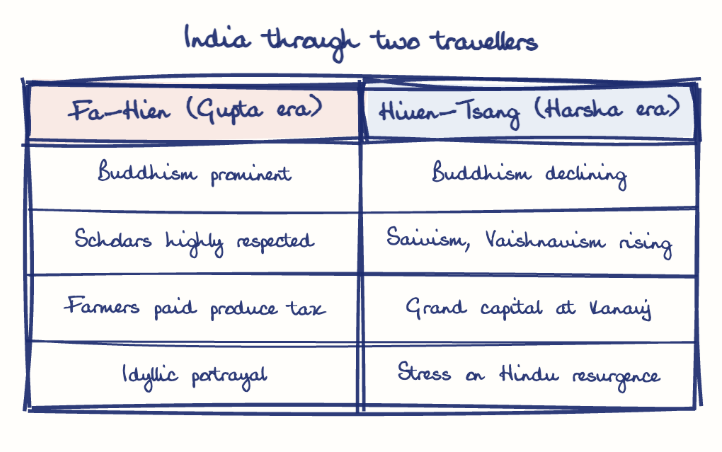
Fa-Hien, Hiuen-Tsang and I-Tsang describe a prosperous, religiously plural, varna-stratified society in which Buddhism declined as Hinduism revived, under structured monarchies with light taxation and royal patronage of religion. Hiuen-Tsang detailed Harsha's administration at Kanauj, while I-Tsang recorded Nalanda's monastic education, though Buddhist biases limit their accounts.
Model answer
Ghissu Editorial · Verified 4 Oct 2026 · 262 words
Religious Pluralism and Buddhist Decline
Fa-Hien noted Buddhism’s prominence in Punjab and Bengal, while Hiuen-Tsang observed its decline and Hinduism’s ascendancy, reflecting shifting royal patronage and the moral decline in Buddhist monasteries.
Social Structure and Cultural Practices
The varna system dominated, with Brahmins and scholars respected; temples, music, and dance flourished, as seen in Andhra’s Saivism and Vaishnavism. Fa-Hien also noted that Chandalas lived outside towns, indicating rigid social hierarchies.
Local Governance and Revenue
Fa-Hien recorded farmers paying a share of produce as tax and mild punishments, while Hiuen-Tsang noted light taxation and officials paid through land grants, indicating decentralized elements within the imperial framework.
Religious Patronage as State Policy
Royal endowments of tax-free lands to Brahmins and temple construction reinforced political legitimacy and social cohesion, illustrating the symbiotic relationship between religion and governance.
Primary Scholarly Sources
Their firsthand observations provide rich data on monasteries, customs, and governance, making their writings invaluable for reconstructing early Indian history.
Cultural Biases
Buddhist perspectives sometimes idealize or critique aspects, such as Fa-Hien’s idyllic view of Gupta society or Hiuen-Tsang’s emphasis on Buddhist decline, requiring critical reading to balance subjective views.
This model answer is indicative and the model can make mistakes; please verify key facts independently.
Practise this question
1Get the answer sheet
Sized for this question.
2Write your answer
Timed, by hand.
3Get it marked
Your score and what to fix.
This chapter in the exam
Ancient India - Pre-history, IVC, Vedic, Mauryas, Kushans, Satavahanas, Sangam, Guptas16 questions
Asked in 8 of 8 sittings since 2008
Most tested: Harappan civilisation—urban planning, origin/decline, and continuity.
- 2025Discuss the origin and expansion of the Indus Valley Civilization.
- 2025Briefly analyze the teachings of Buddha and Mahavira.
All 16 questions, sorted by sub-topic, with model answers and practice.
Question from the official APPSC Group-I Mains 2023 paper. Answer written by Ghissu's engine and checked against our editorial standards. Found an error? Tell us and we correct it within 48 hours.