Examine the survival and continuity of Harappan culture in the present times.
In short
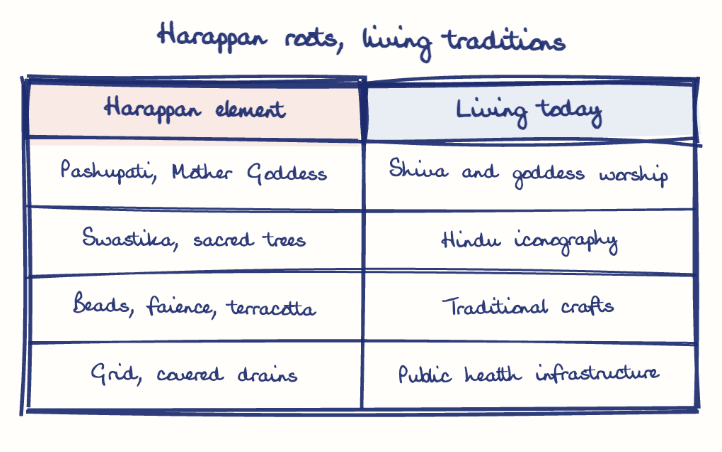
Harappan culture survives in transformed form through religious symbols like Pashupati, the Lingam, Mother Goddess and Swastika, crafts such as bead-making and pottery, urban sanitation principles and standard measurement traditions. The 2021 inscription of Dholavira as a UNESCO World Heritage Site underlines this living continuity.
Model answer
Ghissu Editorial · Verified 4 Oct 2026 · 286 words
Religious Symbols and Practices
Core motifs like Pashupati (proto-Shiva), Lingam, Mother Goddess, sacred trees, serpents, and the Swastika survive, integrated into Hindu worship and iconography, reflecting continuity from ancient localized cults to pan-Indian traditions.
Urban Planning and Sanitation
Harappan grid layouts, standardized bricks, and sophisticated drainage systems influenced later urban designs and public health infrastructure, laying foundational principles for organized habitation.
Craftsmanship and Material Culture
Traditional bead-making, pottery, faience, and metallurgy reflect Harappan artisanal lineage, with techniques passed down through generations and adapted regionally.
Measurement and Trade Systems
Standard weights in binary and decimal ratios show an early tradition of measurement, and long-distance trade set patterns for later Indian commerce.
Cultural Identity and Social Cohesion
Harappan symbols reinforce India’s continuous civilization identity and foster social unity through shared heritage, linking diverse communities via common cultural roots.
Sustainable Practices
Harappan sanitation and urban planning offer lessons for modern sustainable development and public health, inspiring contemporary initiatives.
UNESCO Recognition
Dholavira’s inscription as a UNESCO World Heritage Site in 2021 emphasizes global importance and encourages preservation of Harappan heritage.
Future Directions
Enhance archaeological research using advanced technologies to decipher Harappan script; integrate heritage studies in education; promote traditional crafts through government schemes and GI tags; adapt Harappan urban models for sustainable city planning.
This model answer is indicative and the model can make mistakes; please verify key facts independently.
Practise this question
1Get the answer sheet
Sized for this question.
2Write your answer
Timed, by hand.
3Get it marked
Your score and what to fix.
This chapter in the exam
Ancient India - Pre-history, IVC, Vedic, Mauryas, Kushans, Satavahanas, Sangam, Guptas16 questions
Asked in 8 of 8 sittings since 2008
Most tested: Harappan civilisation—urban planning, origin/decline, and continuity.
- 2025Discuss the origin and expansion of the Indus Valley Civilization.
- 2025Briefly analyze the teachings of Buddha and Mahavira.
All 16 questions, sorted by sub-topic, with model answers and practice.
Question from the official APPSC Group-I Mains 2023 paper. Answer written by Ghissu's engine and checked against our editorial standards. Found an error? Tell us and we correct it within 48 hours.