The state that was created by Shivaji was not only egalitarian in conception but also a welfare state in nature.' Examine.
In short
Shivaji's state was broadly egalitarian, guaranteeing religious neutrality, promoting merit over birth and empowering local leadership, and welfare-oriented, protecting peasants' crops, advancing seed and cattle loans and reforming taxation fairly. Caste hierarchies of a stratified age limited these ideals, yet they prefigure the Constitution's Directive Principles.
Model answer
Ghissu Editorial · Verified 4 Oct 2026 · 255 words
Religious Neutrality and Equality
Shivaji’s state promoted religious neutrality and equal legal protection, ensuring impartial treatment irrespective of caste or creed.
Contested Legacy
Modern debates reveal caste-based contestations and Brahmanical appropriation claims, indicating complexities in fully realizing egalitarian ideals.
Public Works and Economic Security
Shivaji’s administration invested in forts, irrigation, and roads, enhancing agrarian productivity and trade, which strengthened both defense and economic welfare.
Revenue Reforms
Fair taxation policies prevented peasant exploitation, reflecting social justice concerns and equitable resource distribution.
Religious Tolerance
Ensured social harmony, a key welfare objective, by discouraging persecution and fostering peaceful coexistence.
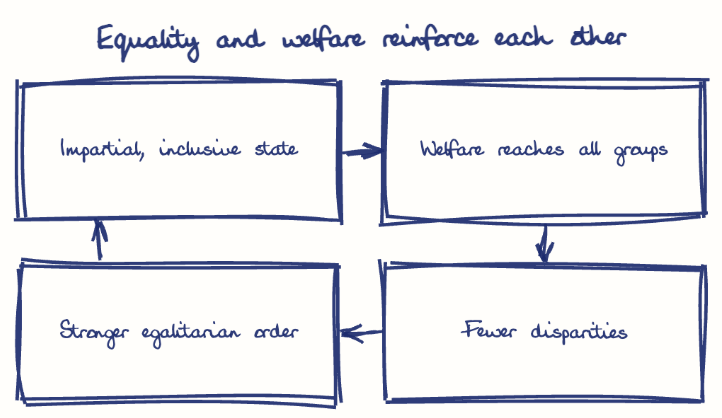
Egalitarianism Enabling Welfare
Impartial governance allowed welfare benefits to reach diverse groups, creating a political environment conducive to inclusive development.
Legacy for Modern Welfare
Shivaji’s model prefigured welfare state principles enshrined in the Indian Constitution’s Directive Principles, emphasizing social justice and protection for all citizens.
Promote Inclusive Narratives
Encourage scholarship acknowledging pluralism and welfare aspects amid caste contestations to foster a balanced understanding of Shivaji’s legacy.
Strengthen Decentralization
Empower local governance institutions to enhance participatory democracy and effective welfare delivery, building on Shivaji’s decentralization efforts.
This model answer is indicative and the model can make mistakes; please verify key facts independently.
Practise this question
1Get the answer sheet
Sized for this question.
2Write your answer
Timed, by hand.
3Get it marked
Your score and what to fix.
This chapter in the exam
The Mughals, the Marathas & the Advent of Europeans10 questions
Asked in 7 of 8 sittings since 2008
Most tested: Shivaji and the Maratha state formation, especially rise, administration and state character.
- 2025Discuss the establishment of the East India Company and its early operations in India.
- 2025What impact did the activities of Christian missionaries have on Indian society and culture?
All 10 questions, sorted by sub-topic, with model answers and practice.
Question from the official APPSC Group-I Mains 2023 paper. Answer written by Ghissu's engine and checked against our editorial standards. Found an error? Tell us and we correct it within 48 hours.