What is meant by Environment Impact Assessment ? Evaluate it. Also give suggestions to make it effective.
In short
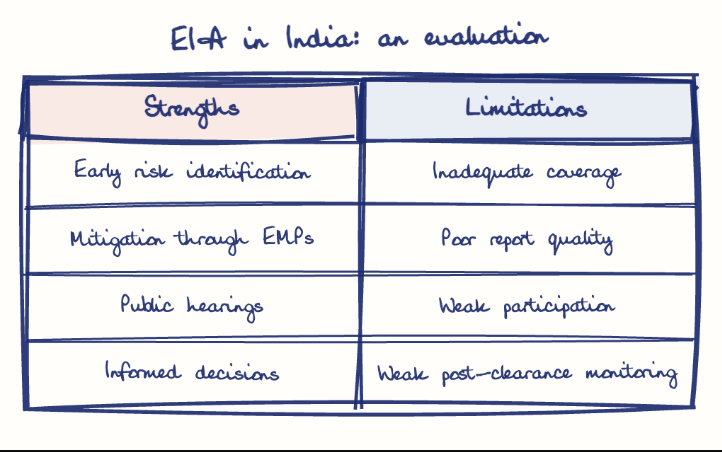
Environmental Impact Assessment is a planning tool that predicts a project's environmental effects early and builds mitigation into an Environment Management Plan, but it suffers from limited coverage, weak reports and hearings, and lax monitoring. An independent EIA authority, wider coverage, full disclosure and strong monitoring would make it effective.
Model answer
Ghissu Editorial · Verified 4 Oct 2026 · 288 words
Mitigation and Public Participation
Environment Management Plans (EMP) guide sustainable practices, with public hearings improving transparency in sensitive regions like Visakhapatnam. These hearings involve local communities, enhancing legitimacy and balancing development with ecological concerns.
Limited Coverage and Transparency
Many projects escape mandatory EIA, and reports often lack biodiversity details; confidentiality of EMPs reduces public trust. This gap is evident in some fast-growing urban areas of Andhra Pradesh where environmental scrutiny lags behind development.
Weak Public Engagement and Monitoring
Public hearings sometimes exclude marginalized groups; post-clearance enforcement is inconsistent, exemplified by gaps in Andhra Pradesh’s urban solid waste management highlighted in the CAG Audit 2022. Additionally, lack of continuous monitoring weakens compliance with environmental safeguards.
Independent EIA Authority
A statutory autonomous body in Andhra Pradesh can ensure impartial assessments free from political influence and industrial pressure, improving credibility.
Robust Monitoring and Enforcement
Use technology and community oversight to ensure compliance with mitigation measures. Strengthening post-clearance monitoring will prevent environmental degradation and align with sustainable development goals.
This model answer is indicative and the model can make mistakes; please verify key facts independently.
Practise this question
1Get the answer sheet
Sized for this question.
2Write your answer
Timed, by hand.
3Get it marked
Your score and what to fix.
This chapter in the exam
Environmental Geography7 questions
Asked in 3 of 8 sittings since 2008
Most tested: Environmental vulnerability and management in Andhra Pradesh, especially drought, pollution control, and disaster impacts.
- 2025Discuss the vulnerability of Andhra Pradesh to cyclones and floods, highlighting the causes, regional patterns, and impacts.
- 2025Analyse the disaster vulnerability of Rayalaseema region in Andhra Pradesh with respect to droughts. Discuss the socio-economic consequences.
All 7 questions, sorted by sub-topic, with model answers and practice.
Question from the official APPSC Group-I Mains 2023 paper. Answer written by Ghissu's engine and checked against our editorial standards. Found an error? Tell us and we correct it within 48 hours.