Are Direct Taxes transferable or non-transferable? Explain the recent Direct Tax Reforms undertaken in India.
In short
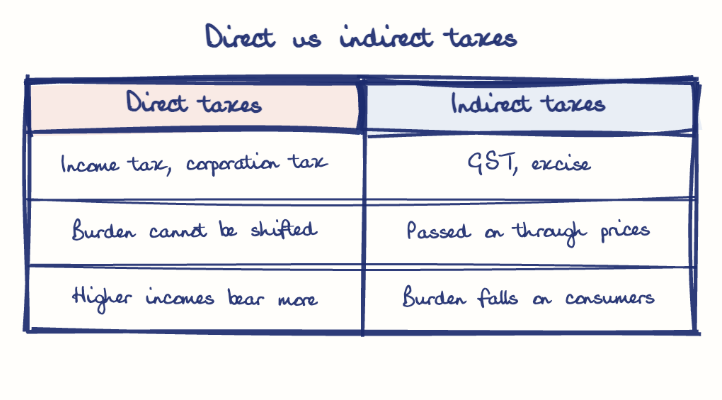
Direct taxes like income tax are non-transferable: their burden falls on the taxpayer, unlike GST, making them progressive and redistributive. Recent reforms include corporate tax cuts to 22% (15% for new manufacturing), faceless assessment, decriminalisation under the Jan Vishwas Act (2023), GAAR and the new Income-tax Act.
Model answer
Ghissu Editorial · Verified 4 Oct 2026 · 265 words
Simplification and Digital Transformation
The Jan Vishwas Act3 (2023) decriminalizes minor tax offences, fostering trust-based governance; digitization via online filing and processing centers enhances transparency.
Incorporation of DTC Proposals
Though the Direct Tax Code bill was not enacted, GAAR and tax rationalization from it are integrated into the Income Tax Act, aiming for a simpler, elastic tax system.
Progressive Rate Adjustments and Compliance
Recent budgets cut corporate tax rates, abolished the Dividend Distribution Tax so dividends are taxed at slab rates, and introduced a simpler new regime; stricter NRI norms widen the tax base.
Enforcement and Anti-Evasion Focus
Enhanced TDS norms and scrutiny of high-value transactions combat evasion; Andhra Pradesh audits show significant underassessment, underscoring enforcement needs.
Taxpayer Education and Technology
Promote awareness and use AI-driven tools to detect evasion, focusing on sectors with high non-compliance as per state audits.
Broaden Tax Base and Centre-State Coordination
Bring informal sectors under tax net without burdening vulnerable groups; align reforms with state fiscal policies, especially in Andhra Pradesh.
This model answer is indicative and the model can make mistakes; please verify key facts independently.
Practise this question
1Get the answer sheet
Sized for this question.
2Write your answer
Timed, by hand.
3Get it marked
Your score and what to fix.
This chapter in the exam
Basic Knowledge of Laws in India6 questions
Asked in 3 of 8 sittings since 2008
Most tested: Contemporary statutory frameworks and their practical relevance, especially cyber law and tax/labour law reforms.
- 2025What do you understand by cyberstalking? What are the various other cyber offences recognised under Information Technology Act, 2000?
- 2025What is GST? Discuss the regulatory framework of GST in India, including Constitutional provisions applicable to GST.
All 6 questions, sorted by sub-topic, with model answers and practice.
Question from the official APPSC Group-I Mains 2023 paper. Answer written by Ghissu's engine and checked against our editorial standards. Found an error? Tell us and we correct it within 48 hours.