Describe the matters in which the Legislative Council stands equal with the Legislative Assembly along with the matters in which it stands unequal with the Legislative Assembly.
In short
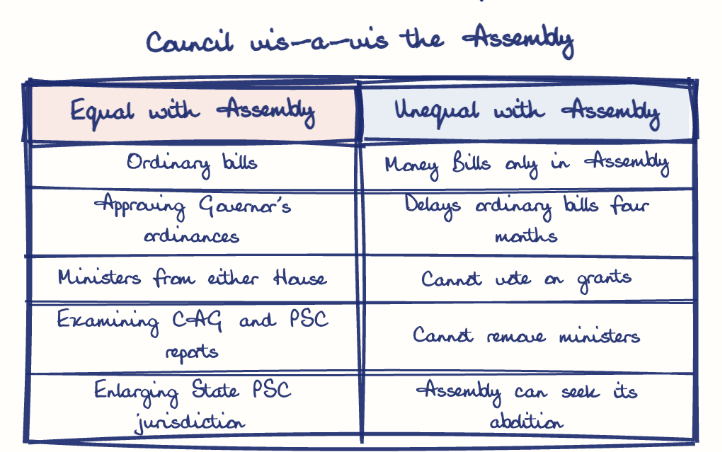
The Legislative Council stands equal with the Assembly in introducing ordinary bills, approving ordinances, supplying ministers and examining constitutional bodies' reports, but unequal in finance and accountability. It cannot originate, amend or reject Money Bills, vote on grants or pass no-confidence motions, and can delay ordinary bills only four months.
Model answer
Ghissu Editorial · Verified 4 Oct 2026 · 268 words
Consideration of Reports from Constitutional Bodies
The Council examines reports from bodies such as the State Finance Commission and the Comptroller and Auditor General of India, contributing to governance scrutiny alongside the Assembly.
Money Bills Exclusivity and Limitations
Only the Assembly can introduce Money Bills; the Council cannot amend or reject them and must return them within 14 days with or without recommendations. The Assembly’s Speaker has final authority on classification, and the Assembly’s decision is conclusive.
No Confidence and Financial Control
The Council cannot pass no-confidence motions or vote on demands for grants, consolidating the Assembly’s exclusive executive and financial control.
Delay Power Over Ordinary Bills
The Council can only delay ordinary bills for up to four months, after which the Assembly’s version prevails, highlighting the Council’s advisory role.
Strengthen Revising Role and Public Awareness
Enhance the Council’s capacity to scrutinize bills through expert committees and research support. Promote public awareness in Andhra Pradesh about the benefits of bicameralism in preventing hasty legislation and incorporating diverse expertise.
This model answer is indicative and the model can make mistakes; please verify key facts independently.
Sources
Practise this question
1Get the answer sheet
Sized for this question.
2Write your answer
Timed, by hand.
3Get it marked
Your score and what to fix.
This chapter in the exam
Parliament and State Legislatures13 questions
Asked in 8 of 8 sittings since 2008
Most tested: Comparative powers and status of the two Houses, especially Rajya Sabha vs Lok Sabha and Legislative Council vs Legislative Assembly.
- 2025In what aspects is the Legislative Council (Vidhan Parishad) different from the Rajya Sabha, considering its role at the state level?
- 2025What are the steps followed by the Indian Parliament in transforming a Bill into an Act?
All 13 questions, sorted by sub-topic, with model answers and practice.
Question from the official APPSC Group-I Mains 2023 paper. Answer written by Ghissu's engine and checked against our editorial standards. Found an error? Tell us and we correct it within 48 hours.