What are the different dimensions of governance? Briefly explain the administrative dimension of governance and its key components.
In short
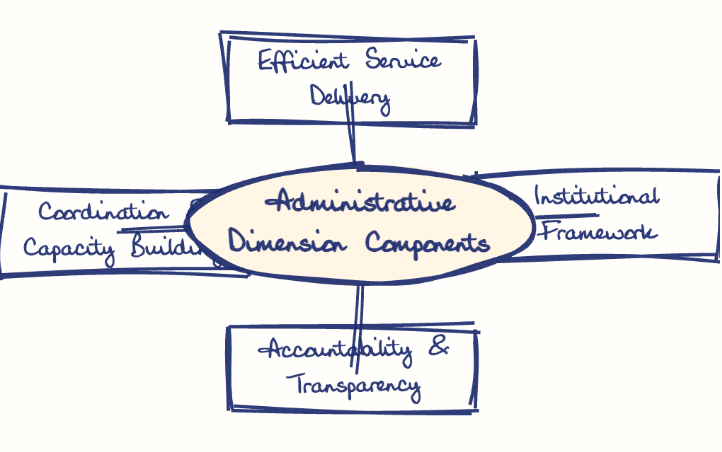
Governance has political, legal and judicial, economic, social and environmental, and administrative dimensions, of which the administrative dimension turns policy into results on the ground. Its key components are efficient public service delivery, an institutional framework, accountability tools like the RTI Act and social audits, and coordination with capacity building.
Model answer
Ghissu Editorial · Verified 4 Oct 2026 · 267 words
Political Dimension
Focuses on political participation, institutional autonomy of bodies like the Election Commission and RBI, and decentralization through the 73rd and 74th Amendments that empower local self-governance.
Legal and Judicial Dimension
Ensures rule of law and access to justice, addressing challenges like case backlogs and delayed justice. Judicial reforms and citizen-friendly policing enhance transparency and accountability.
Efficient Service Delivery
Deals with organizing and managing government machinery to deliver services effectively and transparently. Andhra Pradesh’s digital governance initiatives, such as e-Seva centers, exemplify institutional capacity building and improved service delivery through e-governance platforms.
Accountability and Transparency
The Second Administrative Reforms Commission1 emphasized Weberian bureaucracy principles to strengthen ethics and professionalism. Tools like the Right to Information Act and social audits empower citizens to hold administrators accountable.
Challenges
Bureaucratic inertia, procedural delays, capacity constraints, and corruption persist despite reforms, affecting timely service delivery and citizen satisfaction in Andhra Pradesh and beyond.
Way Forward
Strengthen capacity building through continuous training and infrastructure modernization; expand e-governance initiatives across departments; enhance accountability with robust grievance redressal and citizen participation; and promote decentralization by empowering local administrative bodies with resources and autonomy.
This model answer is indicative and the model can make mistakes; please verify key facts independently.
Sources
Practise this question
1Get the answer sheet
Sized for this question.
2Write your answer
Timed, by hand.
3Get it marked
Your score and what to fix.
This chapter in the exam
Good governance, e-governance, RTI and Social Audit8 questions
Asked in 4 of 8 sittings since 2008
Most tested: RTI as a transparency and accountability instrument within good governance
- 2025Define good governance. How does the Right to Information (RTI) Act promote the principles of good governance in India?
- 2025Social audit helps to narrow gaps between vision and reality. Examine the statement and also discuss the impediments in the institutionalisation of social audit in India.
All 8 questions, sorted by sub-topic, with model answers and practice.
Question from the official APPSC Group-I Mains 2023 paper. Answer written by Ghissu's engine and checked against our editorial standards. Found an error? Tell us and we correct it within 48 hours.