What is meant by Public Interest Litigation (PIL) ? Describe the nature of court orders that are passed by courts in PIL cases.
In short
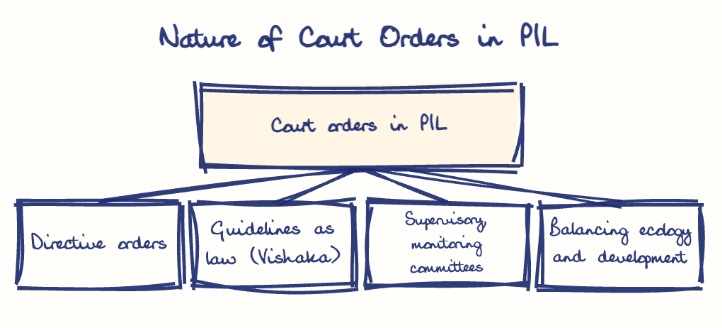
Public Interest Litigation lets any public-spirited person approach the courts under Articles 32 and 226 on behalf of disadvantaged groups, relaxing locus standi. PIL orders are typically directive, supervisory and structural, mandating government action, framing guidelines such as Vishaka, or appointing monitoring committees.
Model answer
Ghissu Editorial · Verified 4 Oct 2026 · 278 words
Relaxation of Locus Standi
Any member of the public with sufficient interest can petition under Articles 32 and 226 to protect collective rights, democratizing access to justice.
Judicial Activism and Ecological Balancing1
The Supreme Court’s activism under Justices Krishna Iyer and Bhagwati institutionalized PIL for bonded labour, undertrial prisoners and environmental protection, with categories framed to filter frivolous petitions.
Directive and Guideline Orders
Courts mandate government action where duties are neglected and frame guidelines where law is absent, as with the Vishaka guidelines on workplace sexual harassment.
Supervisory and Structural Orders
Courts appoint monitoring committees and keep cases open (continuing mandamus) to ensure compliance, while balancing public welfare against individual property and developmental needs.
Screening and Pro Bono Services
Filtering frivolous PILs at admission and promoting pro bono legal aid, especially in Andhra Pradesh, can empower vulnerable groups and reduce misuse, improving judicial efficiency.
Monitoring and Capacity Building
Institutionalizing monitoring mechanisms and enhancing lower courts’ capacity can improve PIL implementation, ensure compliance with court orders, and reduce the burden on higher judiciary.
This model answer is indicative and the model can make mistakes; please verify key facts independently.
Practise this question
1Get the answer sheet
Sized for this question.
2Write your answer
Timed, by hand.
3Get it marked
Your score and what to fix.
This chapter in the exam
Judiciary in India15 questions
Asked in 8 of 8 sittings since 2008
Most tested: Judicial review and its scope/limits
- 2025What are the emergency functions of the Union Government of India? Describe how they impact the legislative powers of Parliament and State Legislatures.
- 2025Discuss any two constitutional amendments that have significantly affected the powers or functioning of the Indian judiciary.
All 15 questions, sorted by sub-topic, with model answers and practice.
Question from the official APPSC Group-I Mains 2023 paper. Answer written by Ghissu's engine and checked against our editorial standards. Found an error? Tell us and we correct it within 48 hours.