Discuss the types and sources of agricultural credit in India. Explain the initiatives taken by the Indian Government in order to improve access to agricultural credit.
In short
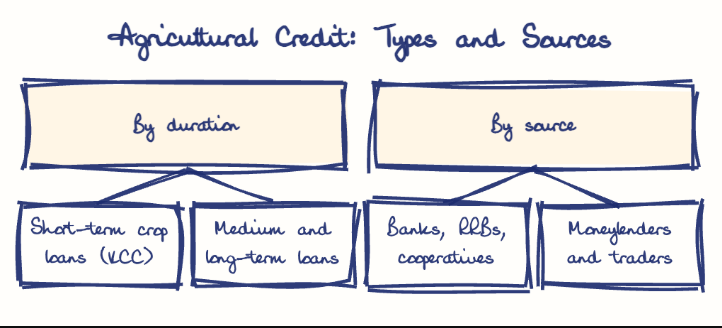
Agricultural credit in India includes short-term crop loans, medium and long-term investment loans, group-based JLG credit and loans for allied activities, sourced mainly from banks, RRBs and cooperatives, though moneylenders still serve about 23% of farmers. Government initiatives include KCC, priority sector lending, interest subvention and the Agriculture Infrastructure Fund.
Model answer
Ghissu Editorial · Verified 4 Oct 2026 · 297 words
Short-term and Long-term Credit
The Kisan Credit Card1 (KCC) scheme2 offers short-term crop loans (collateral-free up to ₹2 lakh, within a limit of ₹5 lakh); bank term loans, refinanced by NABARD, fund asset creation. These loans cover seasonal needs and capital investments like irrigation and machinery.
Institutional and Non-institutional Sources
Institutional credit from commercial banks, RRBs, and cooperatives disbursed over ₹22.8 lakh crore in 2023-24; informal sources still serve 23% of farmers, often at high interest rates. Digital platforms and Pradhan Mantri Jan Dhan Yojana43 enhance inclusion by linking savings accounts to credit access.
Kisan Credit Card and Priority Sector Lending
KCC has over 7.75 crore accounts with ₹9.8 lakh crore loans outstanding; RBI mandates an 18% agriculture sub-target within the 40% Priority Sector Lending target on adjusted net bank credit, ensuring steady institutional credit flow.
This model answer is indicative and the model can make mistakes; please verify key facts independently.
Practise this question
1Get the answer sheet
Sized for this question.
2Write your answer
Timed, by hand.
3Get it marked
Your score and what to fix.
This chapter in the exam
Agricultural Development (India)16 questions
Asked in 7 of 8 sittings since 2008
Most tested: Agricultural credit and market regulation/price policy.
- 2025Examine the significance of agriculture finance, production, and marketing in the context of India's agricultural development. Discuss the challenges and opportunities associated with financing agricultural activities, improving production, and developing efficient marketing systems to support sustainable growth in the agricultural sector.
- 2025Explain the role of the Agricultural Produce Market Committee (APMC) Act in Agricultural Price Policy in regulating the agricultural market in India. What are the issues that have been observed by policy makers regarding the functioning of the APMC Act?
All 16 questions, sorted by sub-topic, with model answers and practice.
Question from the official APPSC Group-I Mains 2023 paper. Answer written by Ghissu's engine and checked against our editorial standards. Found an error? Tell us and we correct it within 48 hours.