Explain the challenges faced by women entrepreneurs in India. Discuss the schemes and initiatives taken by the Indian Government with respect to facilitating women entrepreneurship in India.
In short
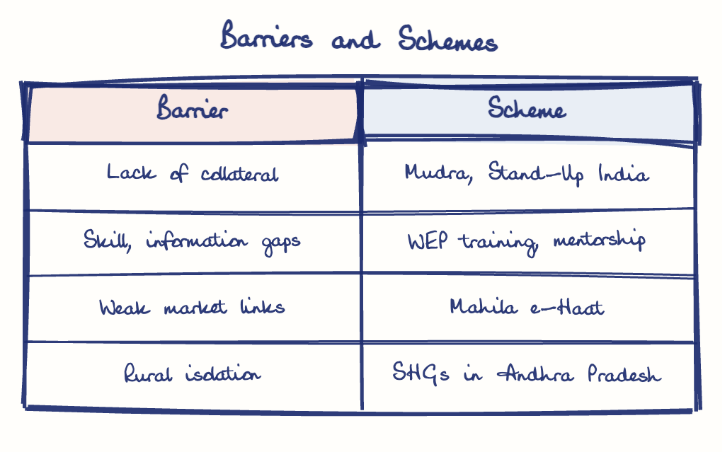
Women entrepreneurs, who own only about 14% of Indian businesses, face unpaid care burdens, lack of collateral, gender bias in lending, skill and information gaps and weak market linkages. Government support includes NITI Aayog's Women Entrepreneurship Platform, PM Mudra Yojana, Stand-Up India and Mahila e-Haat.
Model answer
Ghissu Editorial · Verified 4 Oct 2026 · 255 words
Women Entrepreneurship Platform
Launched by NITI Aayog, WEP provides a digital ecosystem for training, mentorship, financial access, and market linkages, benefiting over 26,500 women since 2018.
Financial Inclusion
Pradhan Mantri Mudra Yojana (PMMY) disbursed INR 2.22 lakh crore loans to 4.24 crore women entrepreneurs in FY 2023-24, easing credit access for micro and small enterprises.
Targeted Support for Marginalised Groups
The Stand-up India scheme mandates at least one woman borrower per bank branch, with 81% of beneficiaries being women, promoting entrepreneurship among Scheduled Castes, Scheduled Tribes, and women.
Socio-Cultural Barriers and Finance
Patriarchal norms limit women’s time for entrepreneurship; lack of collateral and gender bias hinder loan access despite credit growth and a rising CAGR in women seeking credit since 2019.
State-Level Initiatives
Andhra Pradesh’s Self Help Groups (SHGs) empower rural women through collective entrepreneurship, financial literacy, and market linkages, showing effective grassroots support.
Work-Life Balance Support
Promote childcare facilities modelled on SEWA's Sangini childcare cooperative4 in Gujarat, through SHGs in Andhra Pradesh, to help women balance domestic and entrepreneurial roles, enabling sustained participation.
This model answer is indicative and the model can make mistakes; please verify key facts independently.
Practise this question
1Get the answer sheet
Sized for this question.
2Write your answer
Timed, by hand.
3Get it marked
Your score and what to fix.
This chapter in the exam
Inclusive Growth: India and AP schemes49 questions
Asked in 8 of 8 sittings since 2008
Most tested: Women empowerment and poverty reduction through AP welfare and credit-linked institutions
- 2025Elaborate on the meaning of Inclusive Growth in the context of the Indian economy. Discuss the key strategies and instruments that can be employed to foster greater inclusion and ensure that the benefits of economic growth reach all sections of society.
- 2025Critically Examine the major poverty alleviation and employment generation programmes in India. How effective have they been in addressing rural and urban poverty?
All 49 questions, sorted by sub-topic, with model answers and practice.
Question from the official APPSC Group-I Mains 2023 paper. Answer written by Ghissu's engine and checked against our editorial standards. Found an error? Tell us and we correct it within 48 hours.