Explain the impact of rainbow revolution in India. Discuss the scope for Industrial transformation in Indian agriculture.
In short
The Rainbow Revolution has broadened Indian agriculture beyond foodgrains into horticulture, fisheries, dairy and floriculture, raising productivity, farmer incomes, exports and rural employment. Industrial transformation can deepen this through agro-processing clusters and cold chains, mechanisation and precision farming, e-NAM and contract farming, and allied industries like Andhra Pradesh's fast-growing aquaculture.
Model answer
Ghissu Editorial · Verified 4 Oct 2026 · 270 words
Policy Support and Export Promotion
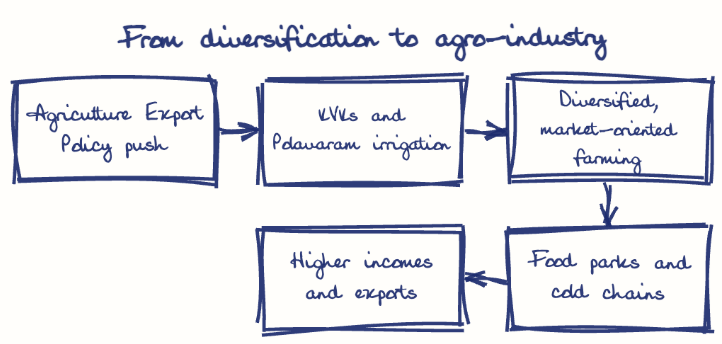
The Agriculture Export Policy and Rainbow Revolution encourage commercialization, evident in Andhra Pradesh’s chilli and horticulture exports.
Extension and Irrigation Development
Revitalized Krishi Vigyan Kendras and projects like Polavaram improve technology access and water availability, enabling multiple cropping.
Post-Harvest Infrastructure Gaps
Inadequate cold storage limits value addition, causing losses in Andhra Pradesh’s horticulture sector.
Smallholder Fragmentation and Credit Issues
Many farmers, especially in Rayalaseema, face credit constraints despite income support under PM-KISAN1.
Environmental Concerns
Intensive cropping stresses soil and water; organic farming efforts in Andhra Pradesh aim to balance productivity and sustainability.
Livelihood Diversification
Allied sectors like aquaculture in Andhra Pradesh’s coastal belt provide significant employment opportunities.
Agro-Processing and Value Addition
Developing food processing clusters and cold chains, as in Andhra Pradesh’s food parks, reduces post-harvest losses and enhances farmer incomes.
Supply Chain Modernization
Strengthening e-NAM and contract farming links farmers directly to markets, fostering industrial growth.
Promotion of Allied Industries
Expansion of livestock, dairy, and fisheries complements crop agriculture, with Andhra Pradesh’s aquaculture sector as a model.
This model answer is indicative and the model can make mistakes; please verify key facts independently.
Sources
Practise this question
1Get the answer sheet
Sized for this question.
2Write your answer
Timed, by hand.
3Get it marked
Your score and what to fix.
This chapter in the exam
Agricultural Development (India)16 questions
Asked in 7 of 8 sittings since 2008
Most tested: Agricultural credit and market regulation/price policy.
- 2025Examine the significance of agriculture finance, production, and marketing in the context of India's agricultural development. Discuss the challenges and opportunities associated with financing agricultural activities, improving production, and developing efficient marketing systems to support sustainable growth in the agricultural sector.
- 2025Explain the role of the Agricultural Produce Market Committee (APMC) Act in Agricultural Price Policy in regulating the agricultural market in India. What are the issues that have been observed by policy makers regarding the functioning of the APMC Act?
All 16 questions, sorted by sub-topic, with model answers and practice.
Question from the official APPSC Group-I Mains 2023 paper. Answer written by Ghissu's engine and checked against our editorial standards. Found an error? Tell us and we correct it within 48 hours.