Explain the regulation of agricultural markets in India. Discuss the scope of farmer-market linkages with a special mention of the e-National Agriculture Market in India.
In short
Agricultural markets in India are regulated mainly by state APMC Acts, supplemented by central MSP and essential commodity policies, which protect farmers but have fragmented markets. Farmer-market linkages are expanding through FPOs and digital platforms, notably e-NAM, which by March 2026 integrated 1,656 mandis with over 1.80 crore farmers registered.
Model answer
Ghissu Editorial · Verified 4 Oct 2026 · 267 words
State Regulation under APMC Acts
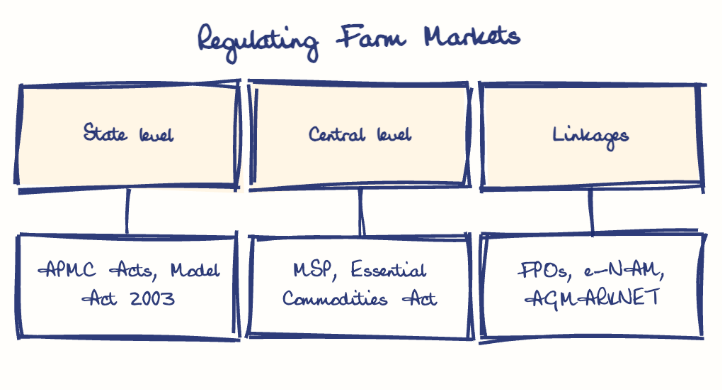
States regulate markets via APMC Acts, requiring sales in designated mandis, which fragments markets and limits farmers’ direct selling options.
Central Policies and Model Acts
Central schemes like MSP and the Essential Commodities Act stabilize prices, while the Model APMC Act 2003 promotes liberalization; Andhra Pradesh’s reforms post-bifurcation exemplify state efforts to improve efficiency.
FPOs and Market Access
Farmer Producer Organizations, supported by Rashtriya Krishi Vikas Yojana, aggregate farmers to improve market reach and credit access, notably in Andhra Pradesh.
Infrastructure and Digital Innovations
Initiatives like AGMARKNET and e-Seva enhance market information access, addressing infrastructure and transparency gaps4.
Unified Electronic Platform
e-NAM connects 1,656 mandis across 23 states and 4 UTs, with over 1.80 crore farmers registered, enabling sales beyond local markets and reducing intermediaries.
Benefits and Challenges
e-NAM improves price realization and lowers transaction costs but faces challenges like limited assaying facilities and legal hurdles; Andhra Pradesh’s integration efforts aim to address these.
Complementary Reforms Needed
Single trading licenses, uniform market fees, dispute resolution, and e-NWR integration are essential for e-NAM’s success.
This model answer is indicative and the model can make mistakes; please verify key facts independently.
Practise this question
1Get the answer sheet
Sized for this question.
2Write your answer
Timed, by hand.
3Get it marked
Your score and what to fix.
This chapter in the exam
Agricultural Development (India)16 questions
Asked in 7 of 8 sittings since 2008
Most tested: Agricultural credit and market regulation/price policy.
- 2025Examine the significance of agriculture finance, production, and marketing in the context of India's agricultural development. Discuss the challenges and opportunities associated with financing agricultural activities, improving production, and developing efficient marketing systems to support sustainable growth in the agricultural sector.
- 2025Explain the role of the Agricultural Produce Market Committee (APMC) Act in Agricultural Price Policy in regulating the agricultural market in India. What are the issues that have been observed by policy makers regarding the functioning of the APMC Act?
All 16 questions, sorted by sub-topic, with model answers and practice.
Question from the official APPSC Group-I Mains 2023 paper. Answer written by Ghissu's engine and checked against our editorial standards. Found an error? Tell us and we correct it within 48 hours.