Is the exchange rate of the Indian Rupee fully determined by the market ? Explain the effects of Rupee Depreciation on the Indian Economy. Discuss the role of the RBI in defending the falling rupee.
In short
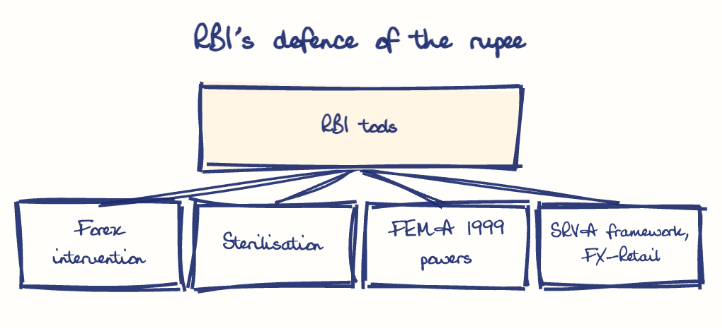
The rupee has been market-determined since 1993 but is not fully free, as the RBI runs a managed float to curb excess volatility. Depreciation aids exports but fuels imported inflation, widens the CAD and triggers outflows, so the RBI defends it with reserves, sterilisation and market intervention.
Model answer
Ghissu Editorial · Verified 4 Oct 2026 · 246 words
Market-Determined Regime with RBI Intervention
Since 1993, the rupee’s value is set by supply-demand in forex markets; RBI intervenes to prevent excessive volatility without fixing exchange rates.
Specialized Forex Facilities
Frameworks like the Special Rupee Vostro Account (SRVA) and Forex Correspondent Scheme1 enhance forex infrastructure, aiding smoother capital flows and exchange rate management.
Imported Inflation and Export Competitiveness
Depreciation raises costs of imports like crude oil, causing inflation, but improves export competitiveness in sectors including Andhra Pradesh’s aquaculture and horticulture.
Capital Outflows and Forex Reserves Pressure
Depreciation triggers capital outflows, affecting market sentiment and widening the current account deficit, pressuring RBI’s forex reserves.
Sterilization and Inflation-Growth Balance
RBI uses sterilization to neutralize forex interventions’ liquidity impact, balancing inflation control and growth support, especially in vulnerable regions like Rayalaseema.
Stable Capital Inflows and Market Deepening
Policies to attract long-term FDI in Andhra Pradesh’s port infrastructure and agro-processing and expanding FX-Retail and Bharat Connect initiatives can reduce volatility.
Targeted Inflation and Export Promotion
Coordinated policies to mitigate inflation’s impact on vulnerable populations and leveraging regional export potential can harness rupee depreciation2 benefits.
This model answer is indicative and the model can make mistakes; please verify key facts independently.
Practise this question
1Get the answer sheet
Sized for this question.
2Write your answer
Timed, by hand.
3Get it marked
Your score and what to fix.
This chapter in the exam
Major Challenges of Indian Economy26 questions
Asked in 8 of 8 sittings since 2008
Most tested: Unemployment and employment structure
- 2025Discuss how infrastructure bottlenecks hinder the growth of the Indian Manufacturing sector. What steps can be taken to address them?
- 2025Analyse the factors contributing to India's Current Account Deficit (CAD) and unfavourable Balance of Payments (BoP) and discuss their implications for the Indian economy.
All 26 questions, sorted by sub-topic, with model answers and practice.
Question from the official APPSC Group-I Mains 2023 paper. Answer written by Ghissu's engine and checked against our editorial standards. Found an error? Tell us and we correct it within 48 hours.