What is meant by the 'Goods and Services Tax' (GST) ? Explain the steps taken by the Indian Government to facilitate trade and 'ease of doing business' under the GST regime.
In short
GST, introduced on 1 July 2017, is a destination-based consumption tax that unified central and state indirect taxes under a dual CGST-SGST structure, with IGST on inter-state supplies. Trade was eased through the Composition and QRMP schemes, faster export refunds, the E-Way Bill and the GSTN portal.
Model answer
Ghissu Editorial · Verified 4 Oct 2026 · 314 words
GST Council as Apex Body
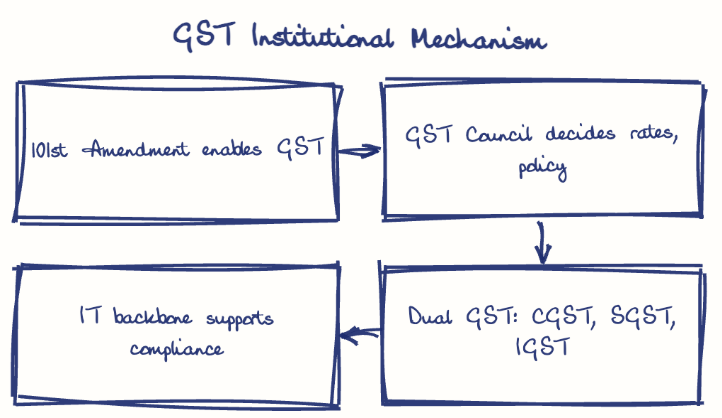
Chaired by the Union Finance Minister with state finance ministers, the GST Council decides tax rates, exemptions, and procedures, ensuring cooperative federalism with two-thirds state votes.
Dual GST Structure and Compensation
CGST and SGST apply on intra-state supplies, IGST on inter-state; a compensation scheme guarantees states 14% revenue growth for five years, cushioning fiscal impact.
Simplified Compliance Schemes
The Composition Scheme and QRMP Scheme ease compliance for small taxpayers and MSMEs by allowing quarterly filings and lower tax rates.
GST Network (GSTN)
Provides a unified digital platform for registration, returns, payments, and grievance redressal, supported by the GST Grievance Redressal Committee to resolve disputes efficiently.
IT Upgrades and Export Support
Features like electronic invoicing, automated input tax credit matching, and expedited refunds (90% within seven days for exporters) improve compliance, reduce errors, and enhance liquidity.
Expand Composition Scheme
Broaden scope, especially in Andhra Pradesh, to ease tax burdens on small businesses and formalize the informal sector.
Strengthen State Capacity
Enhance GST administration and dispute resolution in states like Andhra Pradesh to maintain cooperative federalism and fiscal health.
This model answer is indicative and the model can make mistakes; please verify key facts independently.
Practise this question
1Get the answer sheet
Sized for this question.
2Write your answer
Timed, by hand.
3Get it marked
Your score and what to fix.
This chapter in the exam
Government Budgeting (Union)15 questions
Asked in 6 of 8 sittings since 2008
Most tested: Finance Commission, deficits, and fiscal consolidation in the Indian federal budget system.
- 2025What do you understand by Government Budget? Briefly explain the types of public expenditure and how these expenditures are classified in the government budget.
- 2025Define the term 'deficit' in government finance. Explain the various types of deficits and their economic implications.
All 15 questions, sorted by sub-topic, with model answers and practice.
Question from the official APPSC Group-I Mains 2023 paper. Answer written by Ghissu's engine and checked against our editorial standards. Found an error? Tell us and we correct it within 48 hours.