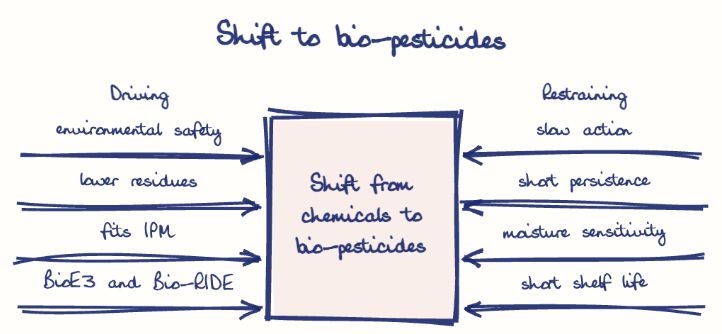
Bio-pesticides are slower in action compared to conventional pesticides, with shorter persistence and susceptible to unfavourable environmental conditions, but still there is a need to shift towards Bio-pesticides — Explain why.
In short
The shift to bio-pesticides is needed because their weaknesses, slow action, short persistence and weather sensitivity, are solvable problems of formulation, storage and training. Chemical pesticides cause lasting damage through resistant pests, residues in food and harm to soil life, so long-term health and the BioE3 Policy justify the shift.
Model answer
Ghissu Editorial · Verified 4 Oct 2026 · 233 words
Slower Action and Environmental Dependence
Bio-pesticides act slower due to biological modes like infection, and their effectiveness depends on favorable conditions such as humidity, affecting use in dry regions like Rayalaseema, Andhra Pradesh.
Short Persistence and Storage Challenges
Rapid degradation by UV and temperature fluctuations limits residual activity; many require cold storage, reducing shelf life and complicating supply chains.
Eco-friendly and Health-safe
Bio-pesticides are biodegradable and target-specific, minimizing harm to beneficial organisms and reducing pesticide residues, addressing food safety concerns raised by the Central Insecticide Board and Registration Committee (CIBRC).
Policy and Research Support
The BioE3 Policy and Biotechnology Research Innovation and Entrepreneurship Development2 (Bio-RIDE) scheme encourage bio-pesticide innovation; Sri Venkateswara University in Andhra Pradesh supports research and field trials, aiding local adoption.
R&D and Farmer Training
Programs like Emerging Frontiers in Biotechnology (EFB) should enhance formulations; extension services in Andhra Pradesh’s Rayalaseema and coastal regions can improve farmer awareness.
Infrastructure and Incentives
Developing cold chain logistics and providing subsidies under state schemes will support bio-pesticide availability and farmer transition.
This model answer is indicative and the model can make mistakes; please verify key facts independently.
Practise this question
1Get the answer sheet
Sized for this question.
2Write your answer
Timed, by hand.
3Get it marked
Your score and what to fix.
This chapter in the exam
Human diseases; genetic engineering basics; biotechnology in agriculture; vaccines54 questions
Asked in 8 of 8 sittings since 2008
Most tested: Vaccines and immunisation, alongside GM crops/biotech agriculture.
- 2025Discuss the transmission dynamics of respiratory tract infections in densely populated urban settings. Propose effective public health strategies for their prevention.
- 2025Examine how urban infrastructure influences the implementation of preventive measures during microbial disease outbreaks. Suggest technology-driven solutions.
All 54 questions, sorted by sub-topic, with model answers and practice.
Question from the official APPSC Group-I Mains 2023 paper. Answer written by Ghissu's engine and checked against our editorial standards. Found an error? Tell us and we correct it within 48 hours.