Discuss why India did not sign the COP26 pledge to stop deforestation and cut methane gas emission by 2030.
In short
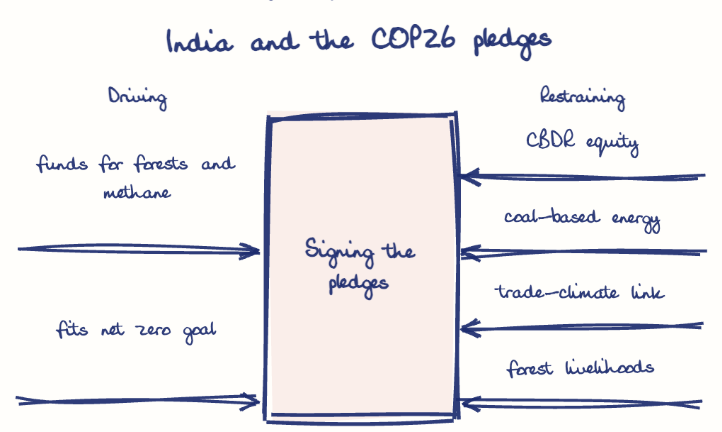
India skipped the COP26 forest and methane pledges because their timelines, trade-linked language and impact on paddy and livestock clashed with equity, food security and sovereignty. It pursues climate action on its own terms instead, through updated NDCs, net zero by 2070 and the Green India Mission.
Model answer
Ghissu Editorial · Verified 4 Oct 2026 · 253 words
Equity and Historical Responsibility
India emphasizes that developed countries, responsible for most historical emissions, should lead climate action, citing its 4% cumulative emissions since 1850 and invoking CBDR.
Developmental Priorities and Energy Security
With about 75% of electricity coal-based, methane largely from paddy and livestock, and forest-dependent livelihoods in Andhra Pradesh’s coastal and forested regions, India demands a phased approach to methane reduction and deforestation halt to protect growth and vulnerable populations.
Constraints on Growth and Forest Communities
Binding targets risk harming rural and tribal populations in Andhra Pradesh’s Rayalaseema and Eastern Ghats reliant on land and biomass energy, requiring balanced policies.
Alignment with National Goals and Finance
While goals align with India’s net-zero by 2070 and enhanced NDCs, immediate timelines and finance uncertainties, including the unmet USD 100 billion a year pledge, cause caution.
Balancing Climate and Poverty Alleviation
India prioritizes emissions intensity reduction alongside energy access and poverty reduction, especially in vulnerable zones like Andhra Pradesh’s Rayalaseema drought belt.
This model answer is indicative and the model can make mistakes; please verify key facts independently.
Practise this question
1Get the answer sheet
Sized for this question.
2Write your answer
Timed, by hand.
3Get it marked
Your score and what to fix.
This chapter in the exam
Pollution & solid waste; global issues; environmental legislation; disaster management policy; agricultural revolutions43 questions
Asked in 8 of 8 sittings since 2008
Most tested: Solid waste management and pollution-control legislation
- 2025What are the key principles of Integrated Solid Waste Management (ISWM)? Discuss the role of waste hierarchy in ISWM.
- 2025Define global warming, and differentiate it clearly from climate change. Explain the key natural and human-induced causes of global warming and briefly discuss which factors are currently dominant in driving global temperature rise.
All 43 questions, sorted by sub-topic, with model answers and practice.
Question from the official APPSC Group-I Mains 2023 paper. Answer written by Ghissu's engine and checked against our editorial standards. Found an error? Tell us and we correct it within 48 hours.