Inefficient farming and poor distribution are reasons for the world's food shortage and the genetically modified crops are a bad answer to the wrong problem — Comment.
In short
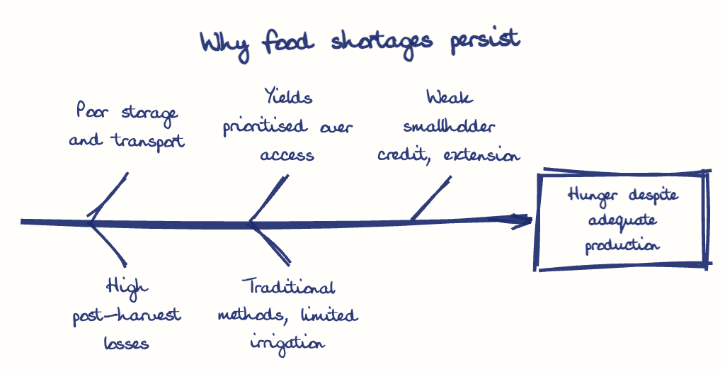
The statement largely holds: world food shortage stems more from inefficient farming, post-harvest losses and unequal access than from low production, so GM crops address the wrong problem. In Andhra Pradesh, costly Bt cotton seeds pushed farmers into debt and pink bollworm developed resistance, while storage gaps persist.
Model answer
Ghissu Editorial · Verified 4 Oct 2026 · 255 words
Distribution and Storage Gaps
Significant post-harvest losses in Andhra Pradesh highlight the failure of infrastructure despite schemes like e-NAM aimed at market integration. These losses reflect fragmented supply chains and inadequate cold storage facilities that prevent food from reaching consumers efficiently.
Farming Inefficiencies and Risks
Traditional farming with limited irrigation in Andhra Pradesh causes stagnation; Bt cotton’s expensive inputs have led to farmer indebtedness and pest resistance in cotton-growing districts. Additionally, many smallholders lack access to credit and extension services, restricting their ability to adopt improved practices or diversify crops.
Distribution Inequities
Poor cold storage and transport infrastructure cause massive food wastage, worsening shortages despite adequate production. This inefficiency is a key factor behind persistent hunger, showing that increasing production alone cannot ensure food security.
Infrastructure Investment
Enhance cold storage, rural roads, and market access in Andhra Pradesh to reduce losses and improve food availability. Strengthening these facilities will help connect farmers1 to markets and reduce wastage.
This model answer is indicative and the model can make mistakes; please verify key facts independently.
Practise this question
1Get the answer sheet
Sized for this question.
2Write your answer
Timed, by hand.
3Get it marked
Your score and what to fix.
This chapter in the exam
Human diseases; genetic engineering basics; biotechnology in agriculture; vaccines54 questions
Asked in 8 of 8 sittings since 2008
Most tested: Vaccines and immunisation, alongside GM crops/biotech agriculture.
- 2025Discuss the transmission dynamics of respiratory tract infections in densely populated urban settings. Propose effective public health strategies for their prevention.
- 2025Examine how urban infrastructure influences the implementation of preventive measures during microbial disease outbreaks. Suggest technology-driven solutions.
All 54 questions, sorted by sub-topic, with model answers and practice.
Question from the official APPSC Group-I Mains 2023 paper. Answer written by Ghissu's engine and checked against our editorial standards. Found an error? Tell us and we correct it within 48 hours.