Though circumstances are strongly insisting for India to overturn decades of 'No first use' nuclear doctrine, still India is committed to No first use of nuclear weapons — Comment.
In short
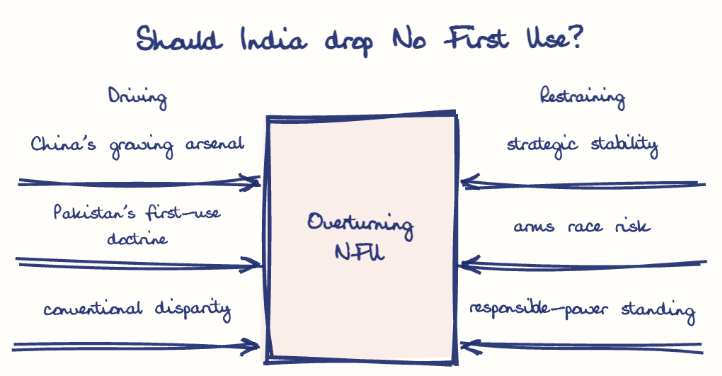
India keeps its 2003 No First Use doctrine despite pressure from a two-front threat, Pakistan's first-use posture and China's growing arsenal, because NFU supports stability, avoids an arms race and marks it as a responsible power. Its credibility rests on assured second-strike capability, shown by INS Arihant's 2018 deterrence patrol.
Model answer
Ghissu Editorial · Verified 4 Oct 2026 · 263 words
Two-Front Nuclear Threats1
China’s nuclear arsenal is projected to reach 1,000 warheads by 2030, while Pakistan’s tactical nuclear weapons and first-use policy lower deterrence thresholds, pressuring India to reconsider NFU.
Conventional Military Disparity
China’s superior conventional forces and aggressive posturing along the Line of Actual Control in Ladakh challenge India’s deterrence, prompting calls for nuclear ambiguity.
Moral and Ethical Foundations
India’s NFU doctrine is rooted in nuclear restraint and global disarmament efforts despite not being an NPT signatory.
Avoiding Arms Race and Command Complexity
Abandoning NFU risks costly command changes and arms race, threatening strategic autonomy and complicating the sea-based deterrent operating from Visakhapatnam.
International Standing and Nuclear Diplomacy
NFU supports India’s image as a responsible nuclear power, facilitating civil nuclear cooperation like the India-Australia uranium deal2.
Maintaining NFU Enhances Stability
It supports deterrence by punishment and India’s diplomatic efforts amid challenges like New START expiry in 2026.
Overturning NFU Risks Escalation
First-use posture could provoke adversaries, increase miscalculation risks, and destabilize South Asia.
Strategic Ambiguity as Middle Path
Ambiguity may enhance deterrence but risks eroding India’s moral high ground and complicates crisis management.
This model answer is indicative and the model can make mistakes; please verify key facts independently.
Practise this question
1Get the answer sheet
Sized for this question.
2Write your answer
Timed, by hand.
3Get it marked
Your score and what to fix.
This chapter in the exam
Energy: needs, resources, policy; Nuclear programme and policy24 questions
Asked in 8 of 8 sittings since 2008
Most tested: Renewable energy transition in India, especially solar/clean energy and barriers to large-scale adoption.
- 2025Differentiate between conventional and non-conventional energy resources. Explain their relevance in India's energy sector.
- 2023What is the current scenario of renewable power generation in India ? Discuss the factors responsible for the growing focus and shift towards Renewable energy.
All 24 questions, sorted by sub-topic, with model answers and practice.
Question from the official APPSC Group-I Mains 2023 paper. Answer written by Ghissu's engine and checked against our editorial standards. Found an error? Tell us and we correct it within 48 hours.