What are e-waste recycling practices in India ? Discuss the highlights of new e-waste management rules 2022 notified by the Government of India.
In short
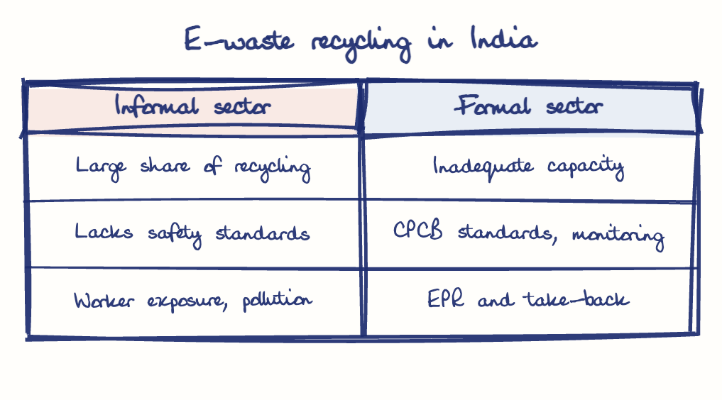
E-waste recycling in India is dominated by an informal sector lacking safety standards, with formal recycling capacity and data still weak. The E-Waste Management Rules 2022 extend EPR to 106 EEE categories, require all handlers to register with CPCB, set annual collection targets and ban landfilling and incineration.
Model answer
Ghissu Editorial · Verified 4 Oct 2026 · 264 words
Central Oversight and EPR
MoEFCC and CPCB regulate e-waste; the 2011 E-Waste Rules introduced Extended Producer Responsibility, and the 2022 Rules require all producers and recyclers to register online for accountability. EPR incentivises eco-friendly product design and reduces toxic materials in electronics.
Local Implementation Gaps and Informal Sector
Andhra Pradesh1’s urban local bodies have few dedicated e-waste collection points and authorised dismantlers, reflecting institutional weaknesses. The informal sector dominates e-waste recycling, operating without safety or environmental standards, causing hazardous exposure and pollution.
Expanded Scope and Targets
The rules cover 106 EEE categories, impose annual collection and recycling targets, and ban landfill disposal of e-waste to ensure environmentally sound processing. This strengthens accountability and promotes circular economy principles.
Capacity Building and Partnerships
Strengthen municipal e-waste centres in Andhra Pradesh with modern technology; foster public-private collaborations and social entrepreneurship to develop model recycling facilities and effective take-back systems.
Data and Awareness
Implement digital tracking mechanisms for accurate e-waste data collection and monitoring; launch targeted awareness campaigns and incentives to boost consumer and producer participation in segregation and recycling.
This model answer is indicative and the model can make mistakes; please verify key facts independently.
Practise this question
1Get the answer sheet
Sized for this question.
2Write your answer
Timed, by hand.
3Get it marked
Your score and what to fix.
This chapter in the exam
Pollution & solid waste; global issues; environmental legislation; disaster management policy; agricultural revolutions43 questions
Asked in 8 of 8 sittings since 2008
Most tested: Solid waste management and pollution-control legislation
- 2025What are the key principles of Integrated Solid Waste Management (ISWM)? Discuss the role of waste hierarchy in ISWM.
- 2025Define global warming, and differentiate it clearly from climate change. Explain the key natural and human-induced causes of global warming and briefly discuss which factors are currently dominant in driving global temperature rise.
All 43 questions, sorted by sub-topic, with model answers and practice.
Question from the official APPSC Group-I Mains 2023 paper. Answer written by Ghissu's engine and checked against our editorial standards. Found an error? Tell us and we correct it within 48 hours.