Assess the role of the Andhra Pradesh Pollution Control Board (APPCB) in post-disaster pollution management.
In short
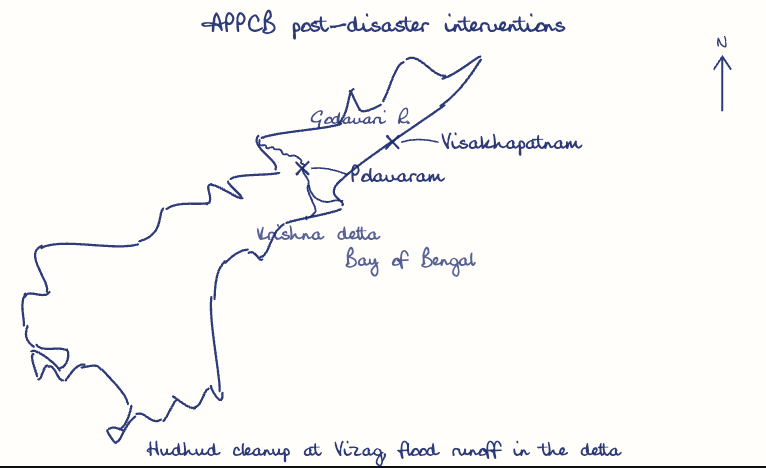
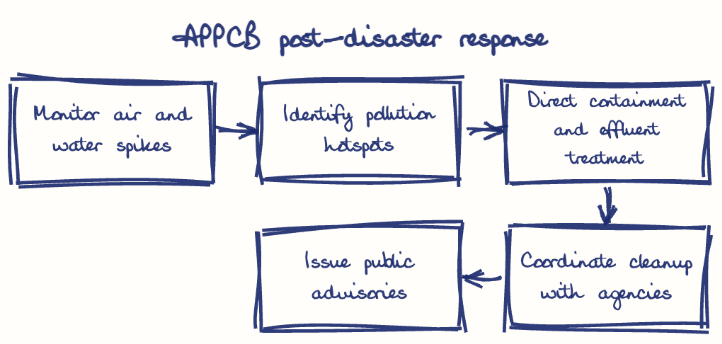
APPCB is central to post-disaster pollution management in Andhra Pradesh through consents under the Water and Air Acts, air and water monitoring, cleanup directions and coordination with disaster authorities, though staff and laboratory shortages limit it. After Cyclone Hudhud (2014), it monitored pollution and directed effluent treatment in Visakhapatnam.
Model answer
Ghissu Editorial · Verified 4 Oct 2026 · 260 words
Regulatory Oversight and Consent Management
APPCB enforces pollution norms post-disaster by granting consents under Water and Air Acts, preventing secondary pollution during recovery phases.
Monitoring and Enforcement
APPCB’s real-time tracking under NCAP5 aided rapid response during Cyclone Fani, but limited manpower and technical resources constrain enforcement.
Institutional and Coordination Issues
The 2022 CAG audit revealed gaps in urban solid waste management6 and highlighted coordination delays with disaster authorities, affecting pollution control.
Cyclone Hudhud Response
APPCB monitored industrial effluents and coordinated cleanup in Visakhapatnam to prevent toxic releases.
Polavaram Project Oversight
APPCB monitored pollutant levels during the Polavaram Irrigation Project7 despite delays and resettlement challenges.
Urban Waste Management
APPCB supervises waste processing in 123 ULBs, but CAG reports expose infrastructure gaps limiting effectiveness.
Capacity Building
Filling vacancies and training staff in disaster-specific pollution control is essential.
Strengthening Coordination
Formal protocols and real-time data sharing with disaster agencies are needed.
This model answer is indicative and the model can make mistakes; please verify key facts independently.
Practise this question
1Get the answer sheet
Sized for this question.
2Write your answer
Timed, by hand.
3Get it marked
Your score and what to fix.
This chapter in the exam
Environmental Geography7 questions
Asked in 3 of 8 sittings since 2008
Most tested: Environmental vulnerability and management in Andhra Pradesh, especially drought, pollution control, and disaster impacts.
- 2025Discuss the vulnerability of Andhra Pradesh to cyclones and floods, highlighting the causes, regional patterns, and impacts.
- 2025Analyse the disaster vulnerability of Rayalaseema region in Andhra Pradesh with respect to droughts. Discuss the socio-economic consequences.
All 7 questions, sorted by sub-topic, with model answers and practice.
Question from the official APPSC Group-I Mains 2025 paper. Answer written by Ghissu's engine and checked against our editorial standards. Found an error? Tell us and we correct it within 48 hours.