How did far trade routes contribute to the exchange of Buddhist ideas in ancient Andhra?
In short
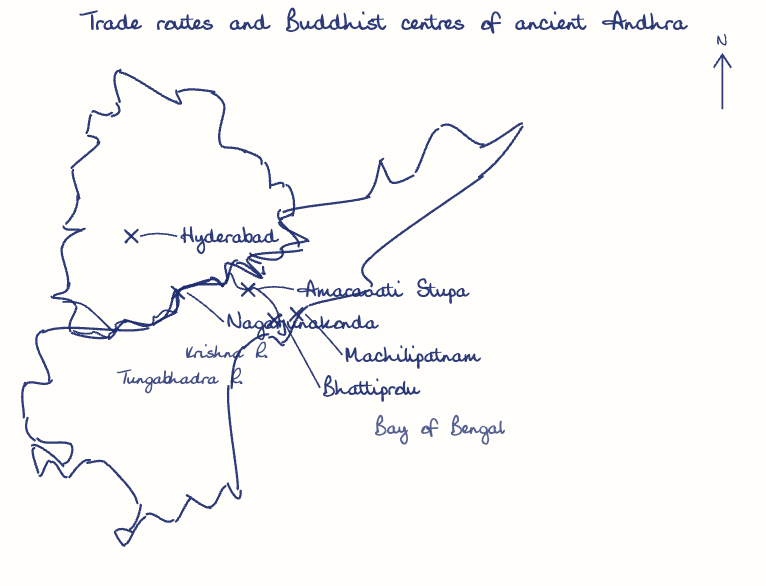
Far trade routes linking Krishna delta ports to the Deccan interior and overseas carried monks alongside merchants, while trade wealth let Gahapatis and Setthis fund stupas and monasteries. Amaravati and Nagarjunakonda became hubs from which Andhra Buddhism reached Sri Lanka and Southeast Asia, as Amaravati-style images at Dong-duong show.
Model answer
Ghissu Editorial · Verified 4 Oct 2026 · 240 words
Strategic Trade Network
Andhra’s east-west corridors connected ports like Machilipatnam to the Deccan and beyond, enabling maritime trade with Southeast Asia and the Roman world.
Economic Prosperity and Patronage
Wealth from trade empowered merchant classes such as the Gahapatis and Setthis to patronize Buddhism, leading to monumental constructions at Amaravati and Nagarjunakonda.
Movement of Monks and Merchants
Buddhist monks traveled with merchants who acted as conduits for spreading Buddhist teachings along these routes.
Cultural and Linguistic Exchange
Trade routes facilitated transmission of Buddhist texts and iconography in Pali and Sanskrit1, influencing regions as far as Vietnam’s Dong-duong site.
Geographical Expansion
Andhra became a base for Buddhist missionary activities reaching Ceylon, Burma, and Southeast Asia, showing how far Andhra’s Buddhist culture travelled.
Architectural Legacy
Trade wealth funded iconic Buddhist art like the Amaravati Stupa, influencing Buddhist iconography across Asia.
Preservation of Heritage
Conservation of Buddhist sites in Andhra Pradesh2 such as Amaravati and Nagarjunakonda is essential.
Promote Cultural Tourism
Developing tourism around ancient trade routes and Buddhist centers can sustain cultural memory.
This model answer is indicative and the model can make mistakes; please verify key facts independently.
Practise this question
1Get the answer sheet
Sized for this question.
2Write your answer
Timed, by hand.
3Get it marked
Your score and what to fix.
This chapter in the exam
Andhra - Ancient16 questions
Asked in 8 of 8 sittings since 2008
Most tested: Satavahana socio-religious and cultural life, especially society, religion, and literature.
- 2025What are the various stories about the origins of Andhra people and the Andhra language?
- 2023Discuss the socio-religious conditions during the Satavahana period with special reference to prominence bestowed on women.
All 16 questions, sorted by sub-topic, with model answers and practice.
Question from the official APPSC Group-I Mains 2025 paper. Answer written by Ghissu's engine and checked against our editorial standards. Found an error? Tell us and we correct it within 48 hours.