What are the various stories about the origins of Andhra people and the Andhra language?
In short
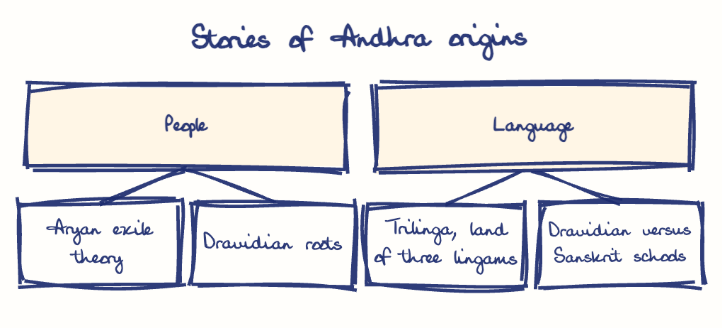
Stories of Andhra origins include the Aitareya Brahmana tale of Vishvamitra's exiled sons, a Dravidian indigenous theory, and a syncretic view of a non-Aryan tribe absorbing Aryan culture. Telugu's names carry their own legends: Tenugu from "tene" (honey) and Telugu from Trilinga, the land of Srisailam, Kaleshwaram and Draksharama.
Model answer
Ghissu Editorial · Verified 4 Oct 2026 · 290 words
Aryan Exile Theory
The Aitareya Brahmana traces the Andhras to the sons of Vishvamitra cursed for refusing to accept Shunahshepa as their elder brother, placing them beyond the Aryan pale and, on this view, south of the Vindhyas. This exile explains their initial non-Aryan status and later cultural assimilation.
Dravidian and Indigenous Roots
Scholars highlight Telugu’s Dravidian linguistic base, suggesting Andhras as indigenous South Indians with temporary northern migration. This view stresses the deep-rooted Dravidian substratum in language and culture.
Syncretic Assimilation
The Andhras’ cultural traits reflect gradual Aryan assimilation, blending ethnic influences over centuries, accounting for mixed linguistic and cultural features.
Political History
The Satavahana dynasty and later Kakatiyas and Vijayanagara Empire institutionalized Telugu culture and identity through literature, temple art, and administration, marking political consolidation of Andhra heritage.
Etymologies of Telugu
Telugu’s names (Andhra Bhasha, Telugu, Tenugu) link to legends and the Trilinga region of Srisailam, Kaleshwaram and Draksharama, symbolizing sacred geography and cultural identity.
Dravidian vs. Sanskrit Schools
Linguists debate Telugu’s roots; Bishop Caldwell championed Dravidian origins, while others emphasized Sanskrit’s role in vocabulary and grammar, reflecting Aryan influence.
Political Role
Early 20th-century movements and journals like Deshabhimani and Andhra Mahasabha conferences fostered Telugu pride, culminating in Andhra State (1953), the first linguistic state, and Andhra Pradesh (1956).
This model answer is indicative and the model can make mistakes; please verify key facts independently.
Practise this question
1Get the answer sheet
Sized for this question.
2Write your answer
Timed, by hand.
3Get it marked
Your score and what to fix.
This chapter in the exam
Andhra - Ancient16 questions
Asked in 8 of 8 sittings since 2008
Most tested: Satavahana socio-religious and cultural life, especially society, religion, and literature.
- 2025How did far trade routes contribute to the exchange of Buddhist ideas in ancient Andhra?
- 2023Discuss the socio-religious conditions during the Satavahana period with special reference to prominence bestowed on women.
All 16 questions, sorted by sub-topic, with model answers and practice.
Question from the official APPSC Group-I Mains 2025 paper. Answer written by Ghissu's engine and checked against our editorial standards. Found an error? Tell us and we correct it within 48 hours.