Define attitude. How does attitude affect the behaviour of public servants?
In short
Attitude is a learned, enduring mental readiness to respond to people, objects or ideas (Gordon Allport), with cognitive, affective and behavioural components. In public servants, positive, democratic attitudes build motivation, empathy and public trust, while rigid bureaucratic attitudes breed red-tapism, and attitude-behaviour conflicts cause cognitive dissonance (Leon Festinger).
Model answer
Ghissu Editorial · Verified 4 Oct 2026 · 255 words
Allport’s Definition
Attitude is a learned predisposition influencing responses, not a fixed trait, crucial in public service behaviour.
CAB Model Components
Cognitive (beliefs), Affective (emotions), and Behavioural (actions) together determine how civil servants engage with challenges.
Positive Attitude and Emotional Intelligence
Training in emotional intelligence enhances resilience and empathy, as highlighted by the Prime Minister on Civil Services Day.
Contrasting Attitudes
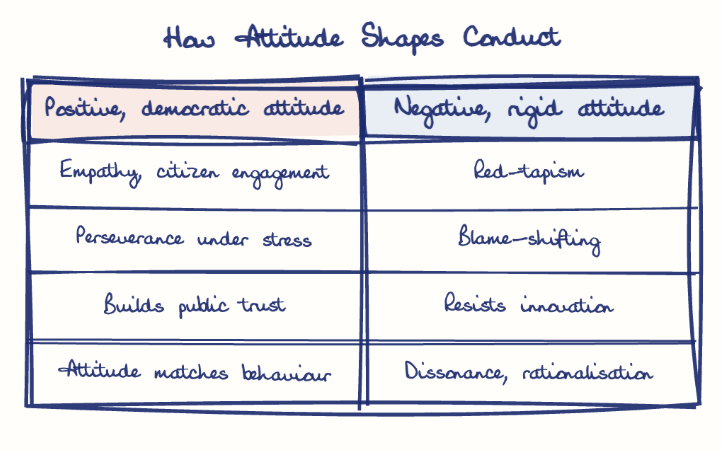
Bureaucratic rigidity versus democratic responsiveness affects governance style and citizen engagement.
Cognitive Dissonance
Festinger’s theory explains how conflicting attitudes and behaviours cause discomfort, leading to inconsistent policy enforcement.
Public Trust and Accountability
Democratic attitudes foster empathy and integrity, enhancing legitimacy and citizen participation.
Negative Attitudes’ Risks
Bureaucratic inflexibility and blame-shifting cause red-tapism and alienate citizens, undermining efficiency.
Emotional Intelligence Training
Regular programs to build self-awareness and positive attitudes under stress.
Promote Democratic Attitudes
Andhra Pradesh’s participative governance models balance efficiency with citizen responsiveness.
Role Model Leadership
Senior officers must exemplify integrity and empathy to shape attitudes.
Feedback Mechanisms
Continuous monitoring in Andhra Pradesh to align attitudes and behaviour, addressing cognitive dissonance.
This model answer is indicative and the model can make mistakes; please verify key facts independently.
Practise this question
1Get the answer sheet
Sized for this question.
2Write your answer
Timed, by hand.
3Get it marked
Your score and what to fix.
This chapter in the exam
Attitude and Emotional intelligence6 questions
Asked in 3 of 8 sittings since 2008
Most tested: Attitude as a determinant of public servant behaviour, including its components and behavioural impact.
- 2025Explain the difference between cognitive, affective and behavioural components of attitude with suitable examples in the public service context.
- 2023Do attitudes influence behaviour? Discuss the polarization of political attitudes in India.
All 6 questions, sorted by sub-topic, with model answers and practice.
Question from the official APPSC Group-I Mains 2025 paper. Answer written by Ghissu's engine and checked against our editorial standards. Found an error? Tell us and we correct it within 48 hours.