Explain the difference between cognitive, affective and behavioural components of attitude with suitable examples in the public service context.
In short
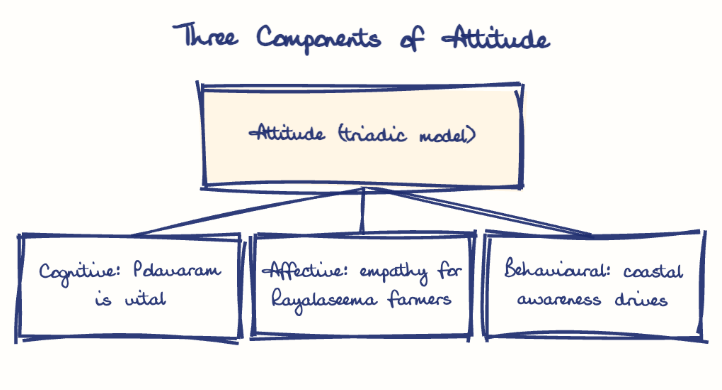
Attitude's cognitive component is belief and knowledge, its affective component is feeling, and its behavioural component is action toward the attitude object. An officer convinced of Polavaram's value (cognitive), a Rayalaseema collector feeling empathy for drought-hit farmers (affective) and one running awareness drives in Visakhapatnam (behavioural) illustrate each.
Model answer
Ghissu Editorial · Verified 4 Oct 2026 · 324 words
Definition and Role
The cognitive component involves beliefs and knowledge about policies and laws, such as a civil servant in Andhra Pradesh supporting the Polavaram project for its socio-economic benefits.
Impact on Behaviour
It guides data-driven decisions, like using empirical evidence from the Jal Shakti Abhiyan to promote water conservation.
Definition and Role
The affective component reflects emotions linked to attitudes, exemplified by a district collector in Rayalaseema empathizing with drought-affected farmers, driving compassionate policy.
Influence on Behaviour
Campaigns like Swachh Bharat leverage affective attitudes to inspire public participation and civil servant commitment.
Definition and Role
Behaviour is the observable action stemming from attitudes, such as a civil servant in Visakhapatnam conducting coastal environmental awareness drives.
Significance
Behavioural consistency builds public trust, supported by ethical guidelines from LBSNAA emphasizing conduct aligned with cognitive and affective components.
Emotional Intelligence Training
Integrate emotional intelligence in Andhra Pradesh civil service training to enhance empathy.
Evidence-Based Policy Education
Provide continuous data access on projects like Polavaram and Jal Shakti.
Behavioural Accountability
Implement monitoring linking attitudes to actions.
Public Campaigns
Use multi-component campaigns like Swachh Bharat tailored to Andhra Pradesh’s context.
This model answer is indicative and the model can make mistakes; please verify key facts independently.
Practise this question
1Get the answer sheet
Sized for this question.
2Write your answer
Timed, by hand.
3Get it marked
Your score and what to fix.
This chapter in the exam
Attitude and Emotional intelligence6 questions
Asked in 3 of 8 sittings since 2008
Most tested: Attitude as a determinant of public servant behaviour, including its components and behavioural impact.
- 2025Define attitude. How does attitude affect the behaviour of public servants?
- 2023Do attitudes influence behaviour? Discuss the polarization of political attitudes in India.
All 6 questions, sorted by sub-topic, with model answers and practice.
Question from the official APPSC Group-I Mains 2025 paper. Answer written by Ghissu's engine and checked against our editorial standards. Found an error? Tell us and we correct it within 48 hours.