Discuss the significance of the 73rd Constitutional Amendment Act in strengthening grassroots democracy in India.
In short
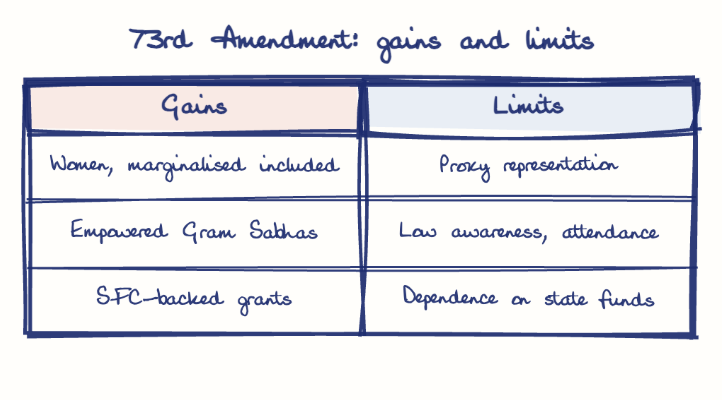
The 73rd Amendment (1992) strengthened grassroots democracy by giving Panchayats constitutional status, regular elections, Gram Sabhas and reservations for SCs, STs and women, devolving powers and funds through State Finance Commissions. Women now form nearly 49.75% of elected Panchayat representatives, though proxy representation and incomplete devolution persist.
Model answer
Ghissu Editorial · Verified 4 Oct 2026 · 258 words
Constitutional Recognition and Fixed Tenure
The Act inserted Part IX, granting Panchayats constitutional status and a fixed five-year term, ensuring stability.
Direct Elections and 33% Women Reservation
It mandated direct elections at all levels with reservations for Scheduled Castes, Scheduled Tribes, and at least one-third women, institutionalizing social justice.
Gram Sabha Empowerment
Recognized as the foundational democratic unit, Gram Sabhas3 approve development plans and hold Panchayats accountable, enhancing participatory democracy.
Increased Political Participation
The Act boosted representation of marginalized groups and women, with women now constituting nearly 49.75% of Panchayat members.
Challenges of Proxy Representation
Despite legal safeguards, patriarchal norms sometimes lead to women acting as proxies, limiting genuine empowerment.
Mandated Devolution of Powers and Finance
States must devolve economic and social development functions and financial resources, institutionalized by State Finance Commissions.
Varied State Implementation
Kerala leads in devolution, while Andhra Pradesh held panchayat polls due in 2018 only in 2021, showing uneven decentralization.
Limitations in Power Devolution
Bureaucratic interference and political patronage often restrict Panchayats’ autonomy.
Strengthen Gram Sabha Functioning
Capacity-building and awareness are essential for active citizen participation.
Ensure Full Devolution
States must comply with constitutional mandates to empower Panchayats fully.
This model answer is indicative and the model can make mistakes; please verify key facts independently.
Practise this question
1Get the answer sheet
Sized for this question.
2Write your answer
Timed, by hand.
3Get it marked
Your score and what to fix.
This chapter in the exam
Local governance (73rd/74th) and Constitutional Authorities13 questions
Asked in 6 of 8 sittings since 2008
Most tested: 73rd Amendment and the Finance Commission’s role in local body devolution/fiscal federalism
- 2025The Finance Commission is considered the backbone of fiscal federalism in India. Examine its role and significance in maintaining the financial balance between the Union and the States.
- 2023Discuss the scope and challenges involved in the political empowerment of women through the Panchayat Raj. Briefly suggest on how to enhance women empowerment in rural and urban local governance.
All 13 questions, sorted by sub-topic, with model answers and practice.
Question from the official APPSC Group-I Mains 2025 paper. Answer written by Ghissu's engine and checked against our editorial standards. Found an error? Tell us and we correct it within 48 hours.