The Finance Commission is considered the backbone of fiscal federalism in India. Examine its role and significance in maintaining the financial balance between the Union and the States.
In short
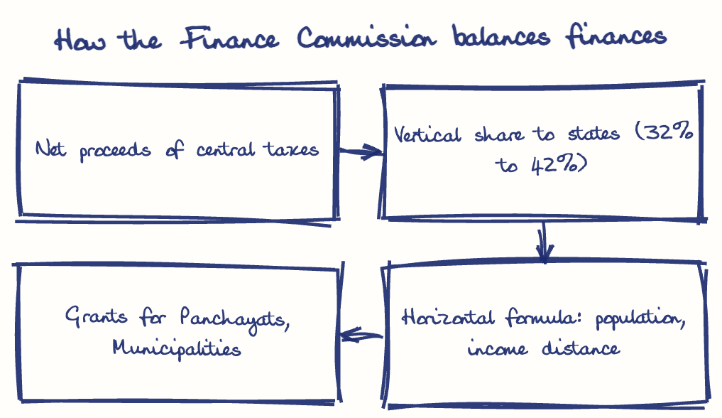
The Finance Commission under Article 280 is the backbone of fiscal federalism because it recommends the vertical sharing of central taxes and the horizontal allocation among states, grants and support for local bodies. The Fourteenth Finance Commission raised the states' share of central taxes from 32% to 42%.
Model answer
Ghissu Editorial · Verified 4 Oct 2026 · 304 words
Constitutional Mandate for Fiscal Equity
It recommends distribution of central taxes ensuring vertical fiscal balance, addressing revenue-expenditure mismatches as per Article 280(3). This constitutional role is vital for sustaining fiscal federalism by aligning resources with responsibilities.
Horizontal Imbalance Correction
It allocates resources among states using parameters like income distance and population, balancing equity and efficiency, exemplified by the Fourteenth Finance Commission3’s historic use of multiple criteria to address disparities.
Enhancing States’ Fiscal Autonomy
The Fourteenth Finance Commission increased states’ share from 32% to 42%, empowering states like Andhra Pradesh to manage development programs with greater financial independence and flexibility.
Mitigating Fiscal Imbalances and Debt Risks
The Sixteenth Finance Commission’s focus on fiscal consolidation helps states with liabilities avoid fiscal distress by recommending grants and loans that promote debt sustainability and fiscal discipline.
Strengthening State Finance Commissions4
Timely constitution and capacity building, including in Andhra Pradesh, will improve fiscal management by providing better data and enhancing local governance financing.
Enhancing Coordination Mechanisms
Better coordination between the Finance Commission, GST Council, and states can harmonize fiscal policies, reduce overlaps, and address issues like population data controversies affecting tax devolution.
This model answer is indicative and the model can make mistakes; please verify key facts independently.
Practise this question
1Get the answer sheet
Sized for this question.
2Write your answer
Timed, by hand.
3Get it marked
Your score and what to fix.
This chapter in the exam
Local governance (73rd/74th) and Constitutional Authorities13 questions
Asked in 6 of 8 sittings since 2008
Most tested: 73rd Amendment and the Finance Commission’s role in local body devolution/fiscal federalism
- 2025Discuss the significance of the 73rd Constitutional Amendment Act in strengthening grassroots democracy in India.
- 2023Discuss the scope and challenges involved in the political empowerment of women through the Panchayat Raj. Briefly suggest on how to enhance women empowerment in rural and urban local governance.
All 13 questions, sorted by sub-topic, with model answers and practice.
Question from the official APPSC Group-I Mains 2025 paper. Answer written by Ghissu's engine and checked against our editorial standards. Found an error? Tell us and we correct it within 48 hours.