Education is a vital sector for boosting the development of any nation. Highlight the recent developments in the education policy of the Indian government.
In short
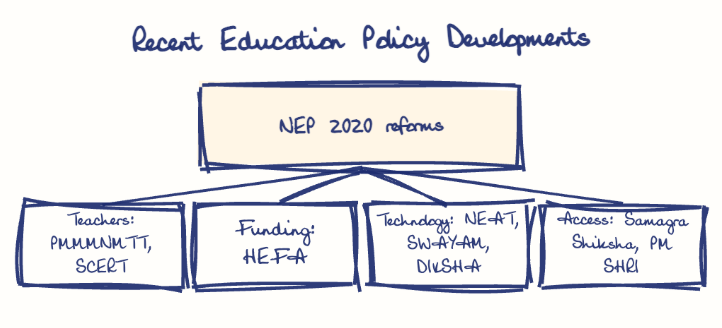
Recent education reforms centre on the National Education Policy 2020, which replaces the 1986 policy with multidisciplinary, outcome-based learning, backed by Samagra Shiksha, PM SHRI and digital platforms like SWAYAM 2.0 and DIKSHA. In Andhra Pradesh, School Education Department budgets have risen, though audits flag teacher vacancies and infrastructure deficits.
Model answer
Ghissu Editorial · Verified 4 Oct 2026 · 253 words
Access and Quality Issues
Schemes like PM SHRI and Samagra Shiksha Abhiyan improve enrolment, but ASER reports highlight stagnant learning outcomes; digital education platforms like SWAYAM 2.0 expanded during COVID-19, yet rural and gender digital divides remain. The NEP’s focus on outcome-based education aims to address these gaps.
State-Level Gaps
Andhra Pradesh65 CAG 2025 audit reveals7 teacher vacancies, infrastructure deficits, and funding gaps in welfare, education, and nutrition schemes, indicating governance challenges. These issues underscore the need for stronger monitoring and accountability mechanisms at the state level.
Digital Inclusion and Data-Driven Policies
Invest in affordable internet and devices; use regular assessments and data analytics to tailor interventions that address specific learning gaps and reduce disparities.
This model answer is indicative and the model can make mistakes; please verify key facts independently.
Practise this question
1Get the answer sheet
Sized for this question.
2Write your answer
Timed, by hand.
3Get it marked
Your score and what to fix.
This chapter in the exam
Government policies and interventions for development4 questions
Asked in 3 of 8 sittings since 2008
Most tested: Government intervention in social-sector development, especially education and health, with implementation issues.
- 2025Although policies formulated by departments are prepared by experts, the results often fall short of expectations. What are the major issues responsible for this gap between policy formulation and implementation?
- 2023Government's intervention in development has seen a long way of impressive outcomes in India. In this connection, discuss the 'Atmanirbhar Bharat' mission aimed at making India Self-Reliant.
All 4 questions, sorted by sub-topic, with model answers and practice.
Question from the official APPSC Group-I Mains 2025 paper. Answer written by Ghissu's engine and checked against our editorial standards. Found an error? Tell us and we correct it within 48 hours.