Critically evaluate the role of education and healthcare in achieving inclusive and sustainable development in India. Highlight the current challenges and government interventions.
In short
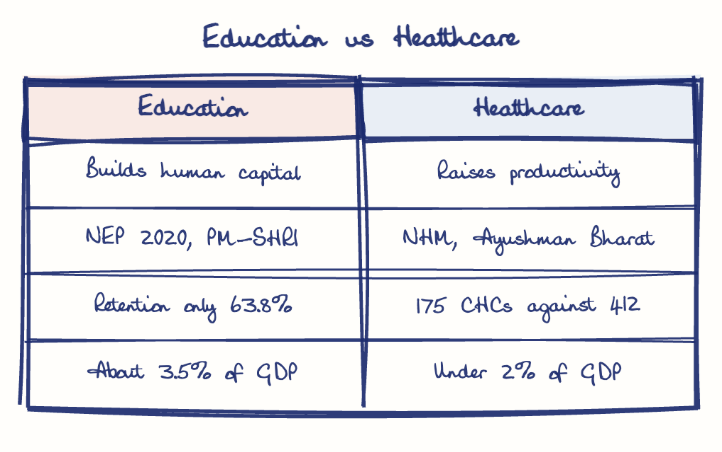
Education and healthcare build the human capital and equity that inclusive, sustainable development needs, but underfunding, quality gaps, staff shortages and unequal access limit them. NEP 2020, Samagra Shiksha, NHM and Ayushman Bharat have widened access, with maternal mortality falling from 130 to 97 per 100,000 live births.
Model answer
Ghissu Editorial · Verified 4 Oct 2026 · 302 words
Skill Development for Sustainability
Platforms like DIKSHA and Atal Tinkering Labs integrate vocational and digital skills, fostering economic resilience. This aligns education with evolving job markets, supporting sustainable livelihoods and innovation.
Health Outcomes and Financial Protection
National Health Mission3 and Ayushman Bharat4 lowered maternal mortality from 130 to 97 per 100,000 (2014-20); however, Andhra Pradesh’s public health expenditure remains low with only 175 CHCs against 412 required and 22% specialist vacancies (CAG 20245). These gaps limit equitable access and quality care.
Emerging Challenges and Infrastructure Gaps
Non-communicable diseases rise, demanding preventive care per National Health Policy 2017; infrastructure and human resource shortages persist, especially in rural areas, affecting service delivery and health outcomes.
Resource and Quality Deficits
Education and health sectors are underfunded (education ~3.5% GDP, health <2% GDP nationally); Andhra Pradesh’s budget shortfalls and staff vacancies highlight implementation gaps. Quality deficits in learning outcomes and healthcare services undermine effectiveness.
This model answer is indicative and the model can make mistakes; please verify key facts independently.
Practise this question
1Get the answer sheet
Sized for this question.
2Write your answer
Timed, by hand.
3Get it marked
Your score and what to fix.
This chapter in the exam
Inclusive Growth: India and AP schemes49 questions
Asked in 8 of 8 sittings since 2008
Most tested: Women empowerment and poverty reduction through AP welfare and credit-linked institutions
- 2025Elaborate on the meaning of Inclusive Growth in the context of the Indian economy. Discuss the key strategies and instruments that can be employed to foster greater inclusion and ensure that the benefits of economic growth reach all sections of society.
- 2025Critically Examine the major poverty alleviation and employment generation programmes in India. How effective have they been in addressing rural and urban poverty?
All 49 questions, sorted by sub-topic, with model answers and practice.
Question from the official APPSC Group-I Mains 2025 paper. Answer written by Ghissu's engine and checked against our editorial standards. Found an error? Tell us and we correct it within 48 hours.