Differentiate between internal and external public debt. Explain their relative advantages and risks for a developing country like India.
In short
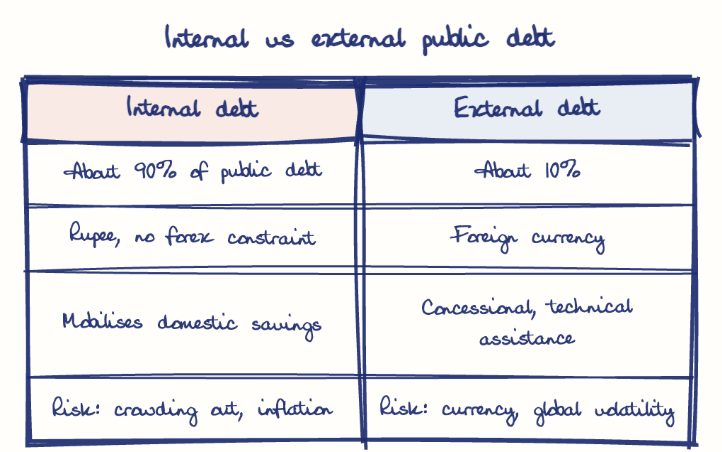
Internal debt is rupee borrowing within India, about 90% of the total, while external debt is foreign-currency borrowing from multilateral bodies, foreign governments and markets. Internal debt avoids currency risk but can crowd out private investment, while concessional external debt is cheaper and longer-term but brings currency and conditionality risks.
Model answer
Ghissu Editorial · Verified 4 Oct 2026 · 340 words
Internal Debt Characteristics
Rupee-denominated and raised domestically through instruments like the Floating Rate Savings Bond, 20201 (Taxable), internal debt is managed primarily by the Reserve Bank of India. It is less exposed to exchange rate fluctuations but can contribute to inflation and liquidity risks.
Internal Debt Benefits
Internal borrowing supports large-scale infrastructure and welfare initiatives, exemplified by the Ujwal DISCOM Assurance Yojana (UDAY) in Andhra Pradesh432, mobilizing domestic savings without immediate foreign exchange constraints. It also reduces vulnerability to external shocks and deepens domestic financial markets through schemes like RBI Retail Direct, which encourages retail investor participation.
External Debt Benefits
External debt provides access to cheaper capital with longer repayment periods, crucial for capital-intensive projects. It bolsters foreign exchange reserves, which currently cover 68.9 percent of external debt, enhancing external sector stability. Additionally, loans from multilateral agencies facilitate technology transfer and policy support, aiding developmental reforms in Andhra Pradesh.
Internal Debt Risks
High internal borrowing can crowd out private investment by absorbing domestic savings, leading to higher interest rates and restricted credit availability, which may hamper job creation and economic growth in states like Andhra Pradesh.
This model answer is indicative and the model can make mistakes; please verify key facts independently.
Practise this question
1Get the answer sheet
Sized for this question.
2Write your answer
Timed, by hand.
3Get it marked
Your score and what to fix.
This chapter in the exam
Resource Mobilization in Indian Economy19 questions
Asked in 7 of 8 sittings since 2008
Most tested: Public debt and its sustainability in post-reform India.
- 2025Discuss the key instruments of Monetary Policy (RBI) and Fiscal Policy in India and evaluate their role in resource mobilisation and inflation management.
- 2023Explain the reasons leading to higher Public Debt in India. Discuss the scope of public debt sustainability in India.
All 19 questions, sorted by sub-topic, with model answers and practice.
Question from the official APPSC Group-I Mains 2025 paper. Answer written by Ghissu's engine and checked against our editorial standards. Found an error? Tell us and we correct it within 48 hours.