Discuss the key instruments of Monetary Policy (RBI) and Fiscal Policy in India and evaluate their role in resource mobilisation and inflation management.
In short
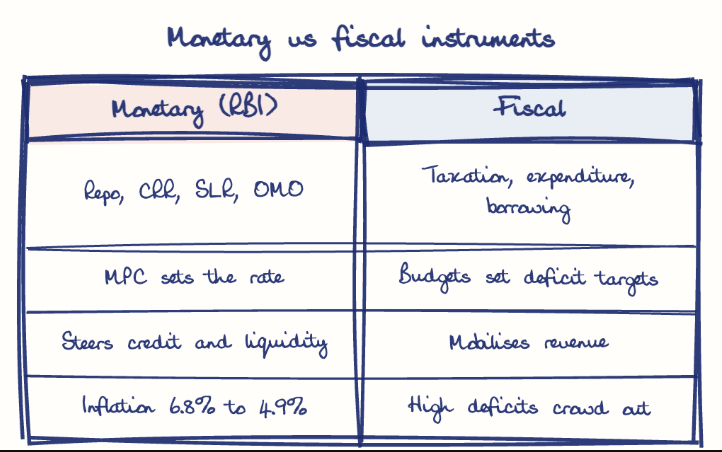
Monetary instruments include the repo rate, CRR and SLR and open market operations, while fiscal instruments are taxation, expenditure, borrowing and subsidies. Inflation targeting cut average inflation from 6.8% (2012-16) to 4.9% after 2016, while taxes and borrowing mobilise resources and duty cuts tame supply shocks.
Model answer
Ghissu Editorial · Verified 4 Oct 2026 · 275 words
Policy Interest Rates and Liquidity
RBI’s repo rate at 5.25%6 and CRR cut to 3% in 2025 ease liquidity, stimulating growth while maintaining inflation within the 2-6% target band.
Open Market Operations and MPC Framework
OMOs manage money supply and support government borrowing, vital for Andhra Pradesh’s development; the MPC ensures transparent, accountable inflation targeting.
Taxation and Expenditure
Andhra Pradesh’s own tax revenue of ₹94,967 crore (2024-25) and a fiscal deficit target of 3.8%7 of GSDP (2026-27) demonstrate effective resource mobilisation and fiscal discipline.
Borrowing and Transfers
The state manages liabilities at 36% of GSDP, with central transfers of ₹89,157 crore aiding fiscal balance but requiring careful management to avoid inflationary risks.
Monetary Policy’s Impact
RBI’s instruments influence credit flow but face challenges from high fiscal deficits crowding out private investment, limiting resource mobilisation effectiveness.
Fiscal Policy’s Impact
Tax reforms and compliance improvements in Andhra Pradesh enhance revenue mobilisation; inflation targeting has reduced average inflation from 6.8% (2012-16) to 4.9% post-2016, though supply shocks remain a challenge.
This model answer is indicative and the model can make mistakes; please verify key facts independently.
Practise this question
1Get the answer sheet
Sized for this question.
2Write your answer
Timed, by hand.
3Get it marked
Your score and what to fix.
This chapter in the exam
Resource Mobilization in Indian Economy19 questions
Asked in 7 of 8 sittings since 2008
Most tested: Public debt and its sustainability in post-reform India.
- 2025Differentiate between internal and external public debt. Explain their relative advantages and risks for a developing country like India.
- 2023Explain the reasons leading to higher Public Debt in India. Discuss the scope of public debt sustainability in India.
All 19 questions, sorted by sub-topic, with model answers and practice.
Question from the official APPSC Group-I Mains 2025 paper. Answer written by Ghissu's engine and checked against our editorial standards. Found an error? Tell us and we correct it within 48 hours.