Discuss the key recommendations of the Fifteenth Finance Commission of India. How do these recommendations influence government budgeting at the centre and state levels?
In short
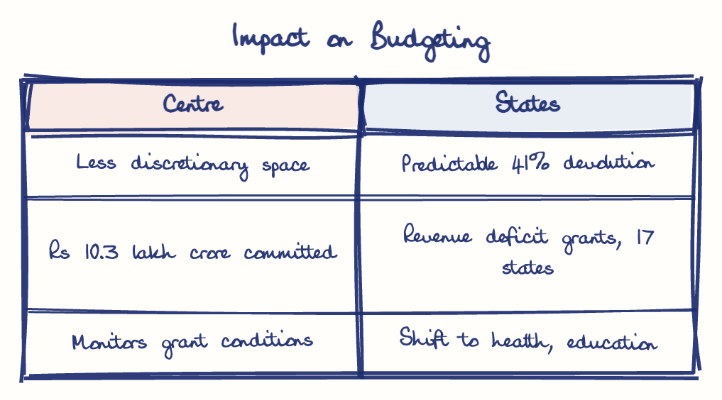
The Fifteenth Finance Commission set states' tax share at 41%, extended revenue deficit grants to 17 states, and added performance-linked health and education grants and local body grants. This narrows the Centre's discretion, committing over Rs 10.3 lakh crore in grants, and gives states predictable resources tied to fiscal discipline.
Model answer
Ghissu Editorial · Verified 4 Oct 2026 · 261 words
Tax Devolution at 41%
The FFC reduced states’ share from 42% to 41%, factoring in new Union Territories, with criteria including income distance (45%), 2011 population (15%), forest cover (10%), demographic performance (12.5%), and tax effort (2.5%).
Performance-Based Incentives
Introduced conditional grants6 linked to health and education outcomes, including health grants through local bodies and education grants tied to a Performance Grading Index, promoting accountability.
Reduced Fiscal Discretion
Fixed 41% tax share limits Centre’s spending7 flexibility, requiring optimized expenditure and borrowing, fostering cooperative federalism.
Increased Grants Commitment
Over Rs 10.3 lakh crore allocated for grants-in-aid, including conditional health and education grants, raising Centre’s fiscal obligations and necessitating fiscal consolidation.
Predictable Resources and Fiscal Autonomy
Stable tax devolution aids medium-term planning; Andhra Pradesh projects 28% own tax revenue growth in 2026-27, enhancing fiscal autonomy.
Fiscal Discipline Pressure
Revenue deficit grants require prudence, yet Andhra Pradesh saw revenue deficit quadruple in 2022-23, highlighting fiscal management challenges despite support.
Local Governance Strengthening
Grants empower local bodies but require capacity building, a challenge in states like Andhra Pradesh for effective fund utilization.
This model answer is indicative and the model can make mistakes; please verify key facts independently.
Practise this question
1Get the answer sheet
Sized for this question.
2Write your answer
Timed, by hand.
3Get it marked
Your score and what to fix.
This chapter in the exam
Government Budgeting (Union)15 questions
Asked in 6 of 8 sittings since 2008
Most tested: Finance Commission, deficits, and fiscal consolidation in the Indian federal budget system.
- 2025What do you understand by Government Budget? Briefly explain the types of public expenditure and how these expenditures are classified in the government budget.
- 2025Define the term 'deficit' in government finance. Explain the various types of deficits and their economic implications.
All 15 questions, sorted by sub-topic, with model answers and practice.
Question from the official APPSC Group-I Mains 2025 paper. Answer written by Ghissu's engine and checked against our editorial standards. Found an error? Tell us and we correct it within 48 hours.