APPSC Group-I Prelims 2012
135 questions from the 2012 papers, each with the official answer and an explanation.
A question repeated across years is listed once, under one of the years it appeared.
- Q81STATE GEOGRAPHY: the ground both states stand on
According to the Central Government Population Census 2011, the rank for Andhra Pradesh in terms of number stands at
- a4th position
- b5th positionAnswer
- c6th position
- d8th position
Explanation
Option B is correct because according to the 2011 Census, united Andhra Pradesh was the 5th most populous state in India, behind Uttar Pradesh, Maharashtra, Bihar, and West Bengal. 1st: Uttar Pradesh 2nd: Maharashtra 3rd: Bihar 4th: West Bengal 5th: Andhra Pradesh (undivided, 2011 Census) Option A: 4th position was held by West Bengal. Option C: 6th position was held by Madhya Pradesh in the 2011 Census rankings. Option D: 8th position is the rank of residual Andhra Pradesh post-bifurcation, but Census 2011 initially ranked undivided Andhra Pradesh 5th.
- Q82Nuclear technology
The first nuclear power plant in India was set up at
- aTarapurAnswer
- bRamagundam
- cJaipur
- dKoodankulam
Explanation
Option A is correct because the Tarapur Atomic Power Station (TAPS), located in Palghar district of Maharashtra, was India's first commercial nuclear power plant, commencing commercial operations in October 1969. Option B: Ramagundam is known for its major National Thermal Power Corporation (NTPC) coal-fired thermal plant and solar plant, not nuclear power. Option C: Jaipur is the capital city of Rajasthan and does not host a nuclear power station. Option D: Koodankulam began operating its first unit in 2013, decades after Tarapur.
- Q83SCHOOL BIOLOGY: life sciences as the papers actually ask them
In which of the following parts of plants does cell division actively occur?
- aStem
- bLeaves
- cRootsAnswer
- dFruits
Explanation
Option C is correct because the root apical meristem, situated just behind the protective root cap, undergoes continuous and rapid mitotic cell division to drive primary root growth. Option A: The majority of mature stem tissue consists of non-dividing permanent tissues, with active division restricted only to narrow terminal and cambial zones. Option B: Fully formed leaves consist of differentiated mesophyll and epidermal cells that have permanently lost the capacity to divide. Option D: In developing and ripe fruits, early cell division ceases and subsequent growth occurs predominantly through cell enlargement.
- Q84SCHOOL BIOLOGY: life sciences as the papers actually ask them
The color of tomatoes is due to this?
- aCarotenoidsAnswer
- bFlavonoids
- cVitamins
- dMineral salts
Explanation
Option A is correct because the bright red color of ripe tomatoes is produced primarily by lycopene, an acyclic pigment belonging to the carotenoid family. Option B: Flavonoids are plant pigments responsible for certain pale yellow, blue, or purple hues, not the characteristic red shade of ripe tomatoes. Option C: Vitamins are essential micronutrients synthesized by plants and do not function as the structural pigments imparting red coloration. Option D: Mineral salts are inorganic nutrients absorbed from soil that maintain cellular osmotic balance without contributing color.
- Q85SCHOOL BIOLOGY: life sciences as the papers actually ask them
The class of animals to which whale belongs is
- aMammalsAnswer
- bReptiles
- cFish
- dAmphibia
Explanation
Option A is correct because whales are warm-blooded aquatic mammals of the order Cetacea that breathe air through lungs, possess mammary glands to nurse their young, and give birth to live calves. Option B: Reptiles are cold-blooded, egg-laying or ovoviviparous animals with scales, which does not describe whales. Option C: Fish breathe dissolved oxygen using gills and are cold-blooded vertebrates, whereas whales possess lungs and mammary glands. Option D: Amphibians undergo metamorphosis and typically live both in water and on land, unlike fully aquatic whales.
- Q86HUMAN BODY, NUTRITION AND DISEASE
The acid produced in the digestive system of human beings is
- aAcetic acid
- bHydrochloric acidAnswer
- cFormic acid
- dNitric acid
Explanation
Option B is correct because the parietal cells in the gastric glands of the stomach secrete hydrochloric acid, which provides the acidic environment necessary for pepsin activation and kills ingested microorganisms. Option A: Acetic acid is the primary acid in vinegar and is not produced by the human digestive system. Option C: Formic acid is present in insect stings and is not synthesized in the human stomach. Option D: Nitric acid is a strong industrial inorganic acid and plays no role in human digestion.
- Q87HUMAN BODY, NUTRITION AND DISEASE
The largest gland in the human body is
- aAdrenal gland
- bPituitary gland
- cLiverAnswer
- dThyroid gland
Explanation
Option C is correct because the liver weighs approximately 1.2 to 1.5 kg in an adult human, making it the largest gland and internal organ in the human body. Option A: Adrenal glands are small endocrine organs located atop the kidneys. Option B: The pituitary gland is a pea-sized master endocrine gland located at the base of the skull, far smaller than the liver. Option D: The thyroid is the largest purely endocrine gland, but its mass is vastly smaller than the liver.
- Q88HUMAN BODY, NUTRITION AND DISEASE
Caused by deficiency of Thiamine (Vitamin B).
- aAnemia
- bBeri-beriAnswer
- cScurvy
- dNight blindness
Explanation
Option B is correct because beri-beri is the hallmark nutritional deficiency disease resulting from inadequate dietary intake of thiamine, also known as vitamin B1. Option A: Anemia results from insufficient red blood cells or hemoglobin, commonly caused by iron, folate, or vitamin B12 deficiency. Option C: Scurvy is caused by a lack of vitamin C, leading to bleeding gums and skin lesions. Option D: Night blindness is caused by a deficiency of vitamin A.
- Q89HUMAN BODY, NUTRITION AND DISEASE
Trachoma disease is related to which part of the body?
- aHeart
- bBrain
- cLungs
- dEyesAnswer
Explanation
Option D is correct because trachoma is a contagious bacterial infection caused by Chlamydia trachomatis that specifically targets the eyes, leading to inflammation and scarring of the conjunctiva and eyelids. Option A: The heart is damaged by conditions such as rheumatic fever or coronary artery disease, not trachoma. Option B: The brain is affected by neurological conditions like encephalitis and meningitis, not trachoma. Option C: The lungs are respiratory organs affected by diseases such as pneumonia and tuberculosis, not trachoma.
- Q90HUMAN BODY, NUTRITION AND DISEASE
The substance used for the treatment muscu-lar pains and paralysis is
- aUltraviolet rays
- bMicrowaves
- cInfra-red raysAnswer
- dRadio frequency waves
Explanation
Option C is correct because infrared radiation penetrates the superficial layers of the skin to produce deep therapeutic heat, which increases local blood circulation, relaxes spasms, and alleviates muscular pains and paralysis symptoms. Option A: Ultraviolet rays are utilized primarily for dermatological disorders such as psoriasis and for vitamin D synthesis, not for deep muscular heating. Option B: Microwaves are primarily used in high-frequency radar, telecommunications, and diathermy devices rather than standard superficial thermal therapy for muscular paralysis. Option D: Radio frequency waves are generally utilized in radio communications, MRI, or specialized ablation procedures rather than routine radiant heat treatment for muscular aches.
- Q91SCHOOL CHEMISTRY
Diamond is an allotrope of
- aSilicon
- bCarbonAnswer
- cHydrogen
- dSodium
Explanation
Option B is correct because diamond is a crystalline allotrope of carbon in which each carbon atom is covalently bonded to four other carbon atoms in a rigid three-dimensional tetrahedral lattice. Option A: Silicon forms similar tetrahedral networks in silicates, but diamond itself contains no silicon. Option C: Hydrogen is a monovalent element that forms diatomic gas molecules, not macromolecular covalent solids like diamond. Option D: Sodium is an alkali metal with metallic bonding and does not form diamond.
- Q92SCHOOL CHEMISTRY
The element which is present in large amounts in rocks and minerals is
- aIron
- bCarbon
- cSiliconAnswer
- dSodium
Explanation
Option C is correct because silicon is the second most abundant element in the Earth crust after oxygen, making up the silicate framework of most rocks and minerals. Option A: Iron is heavily concentrated in the core and ranks fourth in crustal abundance, far below silicon. Option B: Carbon constitutes less than 0.1 percent of the crust by mass and is not the primary constituent of most rocks. Option D: Sodium is present in certain minerals like feldspar, but in much smaller proportions than silicon.
- Q93SCHOOL CHEMISTRY
Milk of magnesia used as anti acid is
- aMagnesium aetate
- bMagnesium hydroxideAnswer
- cMagnesium chloride
- dMagnesium nitrate
Explanation
Option B is correct because milk of magnesia is a basic suspension of magnesium hydroxide, Mg(OH)2, used as an antacid to neutralize excess stomach hydrochloric acid. Option A: Magnesium acetate is a magnesium salt of acetic acid and is not used as milk of magnesia. Option C: Magnesium chloride is a neutral salt formed after neutralization, not the antacid suspension itself. Option D: Magnesium nitrate is a soluble nitrate salt and is not used as an antacid.
- Q94SCHOOL CHEMISTRY
Glass wool means
- aA mixture of glass and wool
- bTransparent wool
- cVery finely powdered glass
- dVery fine glass fibers (threads)Answer
Explanation
Option D is correct because glass wool is an insulating material manufactured by spinning molten glass into exceptionally fine fibres or threads, which are then bonded into a wool-like mat. Option A: Glass wool contains no animal wool; it is entirely composed of vitreous silicate fibres. Option B: Transparent wool refers to optical fibres or synthetic fabrics, not the thermal and acoustic insulating product known as glass wool. Option C: Finely powdered glass is known as glass powder or frit, which lacks the fibrous, intertwined structure of glass wool.
- Q95SCHOOL CHEMISTRY
The ions present in hard water are
- aCalcium and MagnesiumAnswer
- bSodium and Potassium
- cCalcium and Barium
- dSodium and Zinc
Explanation
Option A is correct because water hardness is caused primarily by dissolved polyvalent metallic cations, specifically the dissolved salts of calcium and magnesium. Option B: Sodium and potassium are univalent cations that do not react with soap to form insoluble scum and do not cause hardness. Option C: Barium is found only in negligible trace quantities in natural waters and does not contribute to conventional water hardness. Option D: Sodium does not produce hardness and zinc is present in negligible concentrations under normal conditions.
- Q96SCHOOL CHEMISTRY
Laughing gas (gas that causes laughter)
- aNitric oxide
- bNitrogen peroxide
- cNitrous oxideAnswer
- dNitrogen pentoxide
Explanation
Option C is correct because nitrous oxide (N2O) is commonly known as laughing gas due to the mild euphoria, relaxation, and laughter it induces upon inhalation. Option A: Nitric oxide is a colourless toxic gas and physiological signalling molecule, not laughing gas. Option B: Nitrogen peroxide is a reddish-brown, toxic, and pungent gas. Option D: Nitrogen pentoxide is an unstable white crystalline solid used as an oxidizer.
- Q97SCHOOL CHEMISTRY
What is present in LPG (cooking gas)?
- aPentane
- bButaneAnswer
- cMethane
- dHexane
Explanation
Option B is correct because liquefied petroleum gas used for domestic cooking consists primarily of butane, along with propane, because both liquefy easily under moderate pressure. Option A: Pentane exists as a liquid at room temperature and atmospheric pressure, making it unsuitable as the main constituent of LPG. Option C: Methane is the chief constituent of compressed natural gas and piped natural gas, not LPG. Option D: Hexane is a liquid solvent at room temperature and is not used as a fuel gas in cylinders.
- Q98SCHOOL CHEMISTRY
The gas present in a fire extinguisher
- aHydrogen
- bCarbon dioxideAnswer
- cSulfur dioxide
- dHydrogen sulfide
Explanation
Option B is correct because carbon dioxide is an unreactive, non-combustible gas that smothers fires by displacing atmospheric oxygen. Option A: Hydrogen is a highly flammable fuel gas that burns with explosive force. Option C: Sulfur dioxide is an environmental pollutant and toxic gas that is not used in fire suppression. Option D: Hydrogen sulfide is a toxic and combustible gas that cannot extinguish fires.
- Q99SCHOOL CHEMISTRY
A powerful explosive known by the name Gun Cotton
- aPotassium chlorate
- bCellulose nitrateAnswer
- cPotassium nitrate
- dCellulose acetate
Explanation
Option B is correct because gun cotton is nitrocellulose, prepared by treating cellulose fibres with a mixture of concentrated nitric acid and sulphuric acid to form a powerful low-order explosive and propellant. Option A: Potassium chlorate is an inorganic oxidising salt used in matches and pyrotechnics, not a cotton derivative. Option C: Potassium nitrate is saltpetre, a primary constituent of black gunpowder rather than gun cotton. Option D: Cellulose acetate is a non-explosive ester used in synthetic textiles, plastics, and photographic films.
- Q100SCHOOL CHEMISTRY
The precious gem Ruby, is mainly aluminium trioxide with trace amount of
- aSilver
- bmanganese
- cChromiumAnswer
- dCobalt
Explanation
Option C is correct because ruby is a gemstone variety of the mineral corundum, which is aluminium oxide, where a tiny fraction of aluminium ions are substituted by chromium ions that impart its characteristic red colour. Option A: Silver does not substitute into the corundum crystal lattice to produce ruby. Option B: Manganese gives pink or red tones in other minerals like rhodonite or rhodochrosite, but not in natural rubies. Option D: Cobalt typically acts as a blue colouring agent in minerals and glasses rather than producing the red hue of ruby.
- Q101SCHOOL CHEMISTRY
The tubes used for dialysis and blood transfusion are made of
- aPolyethylene
- bpolysilicon
- cPoly vinyl chlorideAnswer
- dPolybutane
Explanation
Option C is correct because plasticized polyvinyl chloride (PVC) is widely used for manufacturing medical tubing, including blood transfusion and hemodialysis lines, due to its flexibility, chemical stability, and biocompatibility. Option A: Polyethylene is commonly used for containers, bags, and packaging rather than flexible dialysis tubing. Option B: Polysilicon is an inorganic semiconductor material used in solar cells and microelectronics, not flexible medical tubing. Option D: Polybutane is not a standard material used for biomedical tubing applications.
- Q102SCHOOL PHYSICS
The material used for electrical fuse wire should have?
- ahigh resistivity
- btow resistivity
- ctow metting pointAnswer
- dhigh mettig point
Explanation
Option C is correct because a fuse wire must have a low melting point so that the heat generated by an abnormal surge in current quickly melts the wire and safely interrupts the circuit. Option A: high resistivity alone is inadequate if the material cannot melt at safe operational temperatures. Option B: low resistivity produces insufficient heat during a fault condition, failing to trigger the necessary protective break. Option D: a high melting point allows dangerously large currents to persist without breaking the circuit, destroying connected appliances.
- Q103SCHOOL PHYSICS
The percentage of water in milk is measured with
- aLactometerAnswer
- bHydrometer
- cHygrometer
- dPyknometer
Explanation
Option A is correct because a lactometer is a specialized hydrometer designed to measure the relative density of milk, which changes predictably when water is added. Option B: Hydrometer is a general instrument used to measure the specific gravity of liquids, not calibrated specifically for milk purity. Option C: Hygrometer measures humidity or moisture content in the atmosphere. Option D: Pyknometer is a standard laboratory vessel used to measure the density of solids or liquids precisely, not a field tool for milk testing.
- Q104STATE SCIENCE: what the two states run
The place in Andhra Pradesh where the Central Tobacco Research Institute is situated is
- aNellore
- bBapatla
- cGuntur
- dRajahmundryAnswer
Explanation
Option D is correct because the ICAR-Central Tobacco Research Institute (CTRI) was established in 1947 at Rajahmundry in Andhra Pradesh. Option A: Nellore is notable for coastal aquaculture and rice research, not the Central Tobacco Research Institute. Option B: Bapatla is well-known for the Agricultural College and cashew research stations. Option C: Guntur is famous for its large commercial chilli and tobacco trading markets, but the research institute headquarters is in Rajahmundry.
- Q105Logical reasoning and analytical ability
Six boys are standing in a circle each facing the centre. Ashok is left to Phabhu, Sudhakar is between Akash and Prakash, Hari is between Ashok and Akash. Who is left to Prakash?
- aHari
- bPrabhuAnswer
- cAkash
- dSudhakar
Explanation
Option B is correct because arranging the six boys in a circle facing the centre places them in the clockwise order Prabhu, Prakash, Sudhakar, Akash, Hari, and Ashok, which puts Prabhu to the immediate left of Prakash. Ashok is to the left of Prabhu: Ashok is clockwise from Prabhu Hari is between Ashok and Akash: order is Prabhu, Ashok, Hari, Akash counter-clockwise Sudhakar is between Akash and Prakash: completing the circle gives clockwise Prabhu, Prakash, Sudhakar, Akash, Hari, Ashok Facing the centre, the person immediately to the left (clockwise) of Prakash is Prabhu Option A: Hari sits opposite to Prakash, not to his immediate left. Option C: Akash is two places away from Prakash, separated by Sudhakar. Option D: Sudhakar sits to the immediate right of Prakash, not to his left.
- Q106Logical reasoning and analytical ability
If Anitha is taller than Sujatha but shorter than Kumari, and Sujatha is just as tall as kanchana but taller than vanitha then Kanchana is
- ashorter than AnithaAnswer
- bjust as tall as Anitha
- ctaller than Kumari
- dshorter than vanitha
Explanation
Option A is correct because combining the given height comparisons shows that Kanchana is equal in height to Sujatha, who is shorter than Anitha; therefore, Kanchana is shorter than Anitha. Height order from tallest to shortest: Kumari > Anitha > Sujatha = Kanchana > Vanitha Option B: Kanchana is strictly shorter than Anitha, not equal in height. Option C: Kumari is taller than Anitha and therefore taller than Kanchana. Option D: Kanchana is taller than Vanitha, not shorter.
- Q107Series, analogy and odd man out
If the numbers from 4-86 which are exactly divisible by 5 are arranged in descending order, which would come at the eleventh place from the bottom?
- a60
- b65
- c50
- d55Answer
Explanation
Option D is correct because counting from the bottom of a descending list means counting upward in ascending order from the smallest multiple of 5 in the given range. Multiples of 5 from 4 to 86 in ascending order: 5, 10, 15, 20, 25, 30, 35, 40, 45, 50, 55, 60, 65, 70, 75, 80, 85 1st from bottom = 5 11th from bottom = 5 x 11 = 55 Option A: 60 corresponds to the 12th position from the bottom. Option B: 65 corresponds to the 13th position from the bottom. Option C: 50 corresponds to the 10th position from the bottom.
- Q108Series, analogy and odd man out
Down - Weight; Love - Hatred; Earth - ?
- aSkyAnswer
- bSun
- cCloud
- dHeight
Explanation
Option A is correct because the given pairs represent antonyms, such as love and hatred, so the natural opposite paired with earth is sky. Option B: Sun is wrong because the sun is a celestial body, not the traditional conceptual opposite of earth. Option C: Cloud is wrong because a cloud is a meteorological feature within the atmosphere, not the polar opposite of earth. Option D: Height is wrong because height is paired with depth, not earth.
- Q109Coding, decoding and relations
If ‘eraser’ is called ‘box’, ‘box’ is called ‘pencil’, ‘pencil’ is called ‘sharpener’ and ‘sharpener’ is called ‘bag’, what is used by a child to write?
- aEraser
- bBox
- cPencil
- dSharpenerAnswer
Explanation
Option D is correct because a child writes with a pencil, and according to the given code substitutions, pencil is called sharpener. Option A: Eraser is what is called box, not the instrument used for writing. Option B: Box is what eraser is called, whereas pencil itself is called sharpener. Option C: Pencil is the real-world writing instrument, but the code explicitly replaces it with sharpener.
- Q110Coding, decoding and relations
In a certain code language, ‘134’ means ‘good and tasty’, ‘418’ means ‘see good pictures’ and ‘829’ means ‘pictures are excellent’, ‘498’ means what?
- aSee tasty pictures
- bPictures are tasty
- cSee excellent picturesAnswer
- dPictures are good
Explanation
Option C is correct because comparing the coded statements reveals the specific code digits for each word, showing that 4, 9, and 8 correspond to see, excellent, and pictures respectively. In 418 and 829, common digit is 8 and common word is pictures, so 8 means pictures. In 829, remaining words are are and excellent for 2 and 9. In 418, remaining words are see and good for 4 and 1. In 498, the combination contains 4 (see), 9 (excellent), and 8 (pictures). Option A: Option A is incorrect because tasty is represented by 3, which is absent in 498. Option B: Option B is incorrect because it contains tasty, which belongs to code 134, not 498. Option D: Option D is incorrect because it accounts for good instead of excellent, which corresponds to 1 rather than 9.
- Q111Coding, decoding and relations
Kiran said, “Raghu's mother is my mother's only daughter.” What is the relationship between Kiran and Raghu?
- aGrandfather
- bFather
- cMaternal Uncle / Paternal UncleAnswer
- dElder Brother / Younger Brother
Explanation
Option C is correct because Kiran's mother's only daughter is Kiran's sister, making Raghu the sister's son and Kiran the maternal uncle. Option A: Grandfather places Kiran two generations above Raghu instead of one. Option B: Father assumes Kiran is Raghu's parent, ignoring that the mother's only daughter is Raghu's mother. Option D: Elder Brother / Younger Brother incorrectly places Kiran and Raghu in the same generation.
- Q112Coding, decoding and relations
Rama was facing East. He walked 4 km forward, then turned to his right and walked 3 km. Again he turned to his right and walked 4 km. Then he turned back. Now in which direction is Rama walking?
- aEastAnswer
- bWest
- cNorth
- dSouth
Explanation
Option A is correct because after completing his turns, Rama ends up facing West, and turning back reverses his orientation to East. Initial movement: East First turn right: South Second turn right: West Turning back: 180-degree turn from West, facing East Option B: West is the direction Rama was facing immediately before he turned back. Option C: North is perpendicular to the final direction of travel. Option D: South is perpendicular to the line along which Rama turned back.
- Q113Shapes, figures and Venn diagrams
How many squares are there in the figure below?
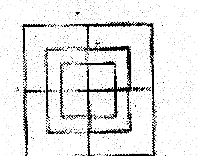
- a13
- b14
- c15Answer
- d16
Explanation coming soon.
- Q114Clocks, calendars and ages
At present Radhika’s age is half of the age of her father. 20 years ago her age was one-fourth the age of her father. What will be the age of Radhika after 12 years?
- a32 years
- b52 years
- c42 yearsAnswer
- d62 years
Explanation
Option C is correct because Radhika is currently 30 years old, so her age after 12 years will be 42 years. Let Radhika's present age be R and Father's present age be 2R R - 20 = (2R - 20) / 4 4R - 80 = 2R - 20 2R = 60, so R = 30 Radhika's age after 12 years = 30 + 12 = 42 years Option A: It adds only 2 years instead of 12 years to her present age. Option B: It calculates her father's age minus 8 years instead of Radhika's age. Option D: It adds 12 years to an incorrect present age of 50.
- Q115Number system and basic operations
If addition is denoted by '-', multiplication by '4', subtraction by '+', and division by 'x', what is the value of 5 + 2 -12 ÷ 6 x 2?
- a19Answer
- b20
- c18
- d22
Explanation coming soon.
- Q116Ratio, percentage and commercial arithmetic
The average of the first five multiples of 4
- a10
- b12Answer
- c15
- d4
Explanation
Option B is correct because the first five positive multiples of 4 form an arithmetic sequence whose central value and average is 12. First five multiples of 4: 4, 8, 12, 16, 20 Sum = 4 + 8 + 12 + 16 + 20 = 60 Average = 60 / 5 = 12 Option A: 10 is the average of the first five natural numbers multiplied by 2, not 4. Option C: 15 exceeds the mean of this sequence. Option D: 4 is only the first multiple, not the average of all five.
- Q117Time, work, speed and distance
A man can do a piece of work in 5 days. With the help of his son, he can do the same work in 3 days. How long will his son take to do the same work alone?
- a6 1/2 days
- b7 days
- c7 1/2 daysAnswer
- d8 days
Explanation
Option C is correct because subtracting the man's individual rate from the joint rate gives the son's individual daily rate. Man's 1-day work = 1/5 Combined 1-day work of man and son = 1/3 Son's 1-day work = 1/3 - 1/5 = 2/15 Time taken by son alone = 15/2 = 7 1/2 days Option A: 6 1/2 days corresponds to a rate of 2/13, which is mathematically incorrect. Option B: 7 days underestimates the exact duration of 15/2 days. Option D: 8 days corresponds to a rate of 1/8, which does not equal 2/15.
- Q118People: appointments, honours and passings
The name of the Air Chief Marshal of India is
- aN.A.K. BrowneAnswer
- bPradeep Vasant Naik
- cSuresh Mehta
- dS.K. Mehra
Explanation
Option A is correct because Air Chief Marshal N.A.K. Browne served as the 23rd Chief of the Air Staff of the Indian Air Force from July 31, 2011, to December 31, 2013, corresponding to the exam period for this question. Option B: Pradeep Vasant Naik served as the Chief of the Air Staff before N.A.K. Browne, from 2009 to 2011. Option C: Suresh Mehta was an Admiral who served as the Chief of the Naval Staff, not the Air Staff. Option D: S.K. Mehra served as the Chief of the Air Staff from 1988 to 1991.
- Q119People: appointments, honours and passings
The Director General of World Trade Organization is
- aPascal LamyAnswer
- bDrunkel
- cAnthony Lake
- dAsha-Rose Migiro
Explanation
Option A is correct because Pascal Lamy of France served as the Director-General of the World Trade Organization for two consecutive terms from 2005 to 2013. Option B: Arthur Dunkel was the Director-General of GATT, the predecessor to the WTO, from 1980 to 1993, not the Director-General of the WTO. Option C: Anthony Lake is an American diplomat who served as the Executive Director of UNICEF, not the WTO. Option D: Asha-Rose Migiro is a Tanzanian politician and diplomat who served as the Deputy Secretary-General of the United Nations, not head of the WTO.
- Q120People: appointments, honours and passings
The Prime Minister of China is
- aWen jiabaoAnswer
- bHu Jintao
- cKirn Hwang-Sik
- dLee Mung-Bak
Explanation
Option A is correct because Wen Jiabao served as the Premier of the State Council of China from 2003 to 2013. Option B: Hu Jintao served as the President of the People's Republic of China, which is the head of state rather than the Premier. Option C: Kim Hwang-sik served as the Prime Minister of South Korea, not China. Option D: Lee Myung-bak served as the President of South Korea, not an official of China.
Keep your place and save questions
Pick up where you stopped, bookmark questions to revise, and get topic-wise PYQ sets with short Telugu notes. Join the waitlist for early access.