Critically examine the resistance of Indian powers against the British Rule and the reasons for their failure.
In short
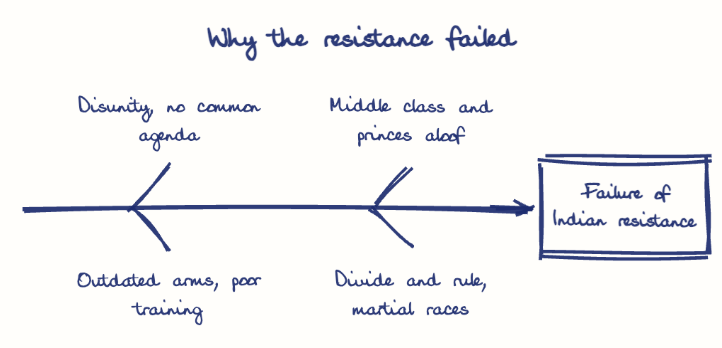
Indian resistance to British rule, from the 1857 revolt to peasant and tribal uprisings, was brave but fragmented, localised and aimed at restoring traditional authority. It failed through disunity, military inferiority, loyalist princes and British divide and rule, as Turrebaz Khan's 1857 attack on the Hyderabad Residency showed.
Model answer
Ghissu Editorial · Verified 4 Oct 2026 · 302 words
Military Revolts
The 1857 Rebellion, led by figures like Mangal Pandey, Rani Lakshmibai, and Nana Saheb, was a major armed resistance against British annexation policies such as the Doctrine of Lapse. It combined sepoy mutinies with princely rebellions but lacked unified leadership and coordination. Earlier military resistances included the fall of Mysore under Tipu Sultan and Maratha wars, which also challenged British expansion.
British Divide-and-Rule and Military Superiority
British policies deepened communal and caste divides, institutionalizing “martial races” recruitment to ensure army loyalty. Superior arms, disciplined regiments, and efficient logistics enabled the British to suppress uprisings decisively. Administrative reforms and legal discrimination also fragmented Indian society, preventing unified opposition.
Inclusive Unity and Modernization
Building national cohesion by overcoming regional, religious, and caste divisions is essential. Strengthening indigenous military capabilities with modern technology and disciplined training is critical to counter external domination. Engaging intellectuals and emerging middle classes can provide ideological coherence and leadership to future resistance movements.
This model answer is indicative and the model can make mistakes; please verify key facts independently.
Practise this question
1Get the answer sheet
Sized for this question.
2Write your answer
Timed, by hand.
3Get it marked
Your score and what to fix.
This chapter in the exam
British conquest and the economic impact of colonial rule2 questions
Asked in 2 of 2 sittings since 2016
Most tested: Colonial economic impact on agriculture, especially commercialisation and its limits.
Question from the official TGPSC Group-I Mains 2016 paper. Answer written by Ghissu's engine and checked against our editorial standards. Found an error? Tell us and we correct it within 48 hours.