'Commercialisation of agriculture did not lead to improved technology in 19th century colonial India.' Examine.
In short
The statement largely holds: 19th-century commercialisation pushed peasants toward cash crops, but exploitative landlordism, heavy revenue, famines and state neglect left farming technology stagnant. Only about 10% of cultivated land used improved seeds by the late 1930s, with gains confined to areas like Arthur Cotton's Godavari and Krishna deltas.
Model answer
Ghissu Editorial · Verified 4 Oct 2026 · 256 words
Emergence of New Landlord Class
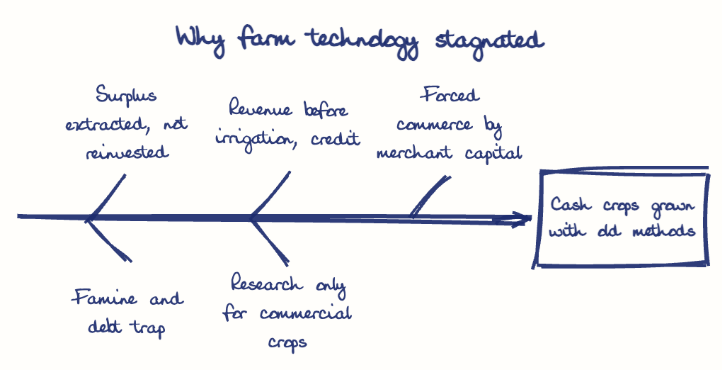
Colonial revenue policies created a capitalist landlord class that accumulated surplus but lacked incentives to invest in agricultural improvements, perpetuating exploitative relations.
Limited Technological Adoption
Only around 10% of cultivated land used improved seeds by the late 1930s; irrigation projects like canal colonies in Northwestern India were limited exceptions.
Exploitative Agrarian Relations
Landlord-tenant dynamics and heavy taxation extracted surplus, disincentivizing investment in technology.
Colonial Policy Priorities
Revenue extraction was prioritized over rural development, leading to neglect of irrigation, credit, and research institutions.
Frequent Famines and Economic Insecurity
Recurring famines and debt burdens forced peasants into subsistence survival, limiting their capacity to adopt new technologies.
Strengthen Public Agricultural Research
Invest in region-specific research and extension services for diverse agro-ecological zones.
Expand Irrigation Infrastructure
Prioritize equitable irrigation projects to reduce monsoon dependence and improve yields.
Enhance Credit Access for Smallholders
Develop affordable credit mechanisms targeting small and marginal farmers to enable investment in technology and inputs.
This model answer is indicative and the model can make mistakes; please verify key facts independently.
Practise this question
1Get the answer sheet
Sized for this question.
2Write your answer
Timed, by hand.
3Get it marked
Your score and what to fix.
This chapter in the exam
British conquest and the economic impact of colonial rule2 questions
Asked in 2 of 2 sittings since 2016
Most tested: Colonial economic impact on agriculture, especially commercialisation and its limits.
Question from the official TGPSC Group-I Mains 2024 paper. Answer written by Ghissu's engine and checked against our editorial standards. Found an error? Tell us and we correct it within 48 hours.